Transit
E5 Fran

< Previous | Index | Next >
Concept Art:
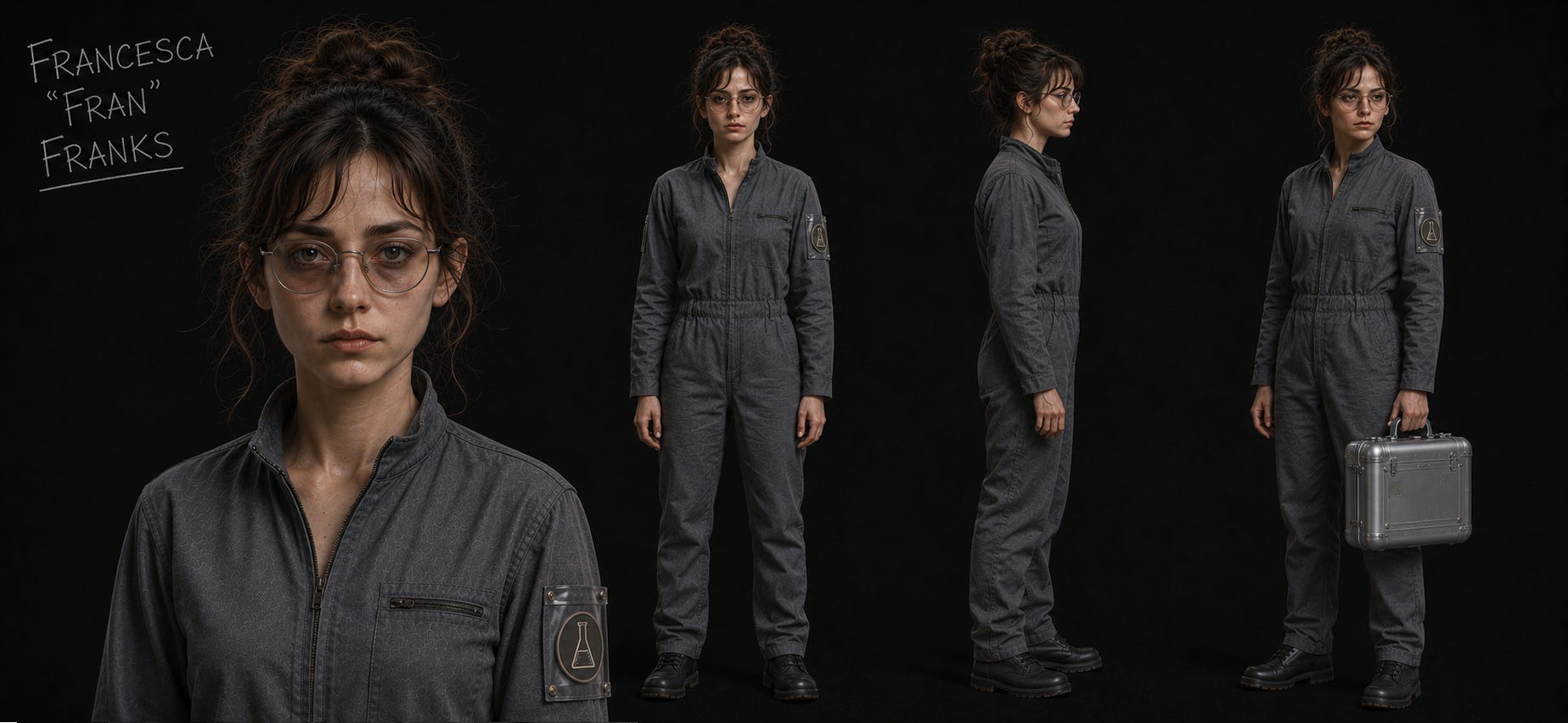
The walk back to the staging bay feels like a victory lap, which is the first mistake Flux makes today.
He has three of them. Amber a half-pace to his left, AI division patch already off and pocketed, her quiet the heavy kind that means the sum has been done and accepted. Vera on his right, Agriculture patch gone from her sleeve, her posture sorted into the forward alignment of a recruit who has finally found the door she spent five years pressing on. Roux behind them both, patched and unsteady, carrying the untethered gravity of someone who walked out of a disposal queue this afternoon and is still waiting for the floor to dissolve beneath the reprieve.
Three names. Three doors. Flux’s thumb finds the two remaining olive branches through the fabric of his pocket, the embroidered discs firm and certain. Five issued. Three placed. Two to go. The arithmetic is clean, and for the length of the corridor he lets himself believe he is the one holding it.
The light has gone to its evening register, the corridors dimming on their cycle to tell a city with no true day and night that it is late. They have spent the whole back half of the day on this. Flux has not eaten since before liberating Roux. He has not noticed.
Boss’s staging space is not an office. It is a waiting room for consequences—a cargo bay halved by a scarred polymer partition, the air thick with old lubricant and the sterile tang of seals checked too often. Somewhere beyond the walls Peregrine sits in its berth, close enough that Flux is aware of it the way you are aware of weather—a fact about the near future, present in the body before it is present in the mind.
Boss is at the dragged-in folding table. He does not look up. There is a cup of chicory at his elbow gone cold enough to skin, and under his hand a paper manifest—not a tablet, paper, a thing that cannot refresh itself behind his eyes or quietly correct him while pretending it was always right.
Flux stops. The three women stop behind him, a single unrehearsed deceleration Boss registers without lifting his gaze.
“Where are the other two.”
It is a flat audit of the room’s occupancy.
The victory lap ends under Flux’s feet.
He had been operating on an assumption he never examined: that Boss was assembling the rest of the cohort from his end, that the mission had a second apparatus moving in the dark, a shadow administration handling the seats Flux could not reach. He understands now, in the time it takes Boss to set the manifest down, that there is no other apparatus. There was never a part of this moving that Flux did not have to move himself.
Boss handed him five and trusted him to understand that five is five.
Flux had not understood five.
He opens his mouth to put something self-incriminating into the room.
“Francesca Franks,” Vera says from half a pace behind his shoulder. “R&D.”
Boss’s eyes move to her. Then briefly to Flux—one clean flash of approval—before settling on Vera again.
“That’s one.”
“That’s the one I’m sure of tonight.” Vera does not step forward to say it; she says it from where she is, which is its own information. “The cells. The energy stock that had to have come from you, from Earth. Someone in R&D has been taking it apart for months without clearance to know what she’s taking apart. If Earth has hardware we can’t build, you want the one mind on Luna already furious she can’t build it.”
A beat.
“I’ll get you the fifth myself. Give me until morning.”
Boss weighs her. There is a visible operation behind his face, a scale that needs a second to stop swinging before the number can be read. He does not ask who the fifth is. He does not ask how a recruit of one day knows the inside of R&D’s work. He takes the competence as given and spends nothing on the rest.
“You’ve briefed them on the Eastern Unit’s ask.”
The name lands differently spoken aloud. The Eastern Unit: the settlement on Earth that had asked Luna for people, not supplies.
“Everything important,” Flux says.
Boss picks up the cup, considers it, and sets it down without drinking.
“Then here is what happens next. I stay here with your other two recruits and finish what Flux started with them.” His eyes move to Amber, to Roux, back. “Flux and Herring, you get Franks. You don’t walk five people into R&D unless you want the whole division asking why.”
That is reason enough. Two can still resemble an errand. Five becomes a spectacle.
“If Franks says yes,” Boss adds, to no one in particular, “don’t linger. R&D will remember how valuable she is the moment someone else asks for her.”
Roux looks at the partition, then at Amber, then at Boss.
“Sure. Stick the newly freed prisoner with the trauma-bonded one.”
Amber does not deny the label. She takes up the pen lying across the manifest and turns the paper toward her.
Roux watches her, then sits on a crate, unwraps something from gray paper, and begins to eat.
So it is Flux, Vera, and Term for the descent.
Flux feels the party shrink and sharpen as it goes.
Vera knows the way to R&D without checking—not from a map, not from habit in the adult sense. The way a person knows a route walked as a child without knowing they are remembering it. Her feet take the angle at the junction before the sign resolves.
Flux keeps pace and does not ask how.
She tells him anyway. Or most of it, in the pieces that come loose as they descend.
“My mother worked there.”
Before the Year 32 mission carried her down with Luna’s first and only attempt to return people to Earth. The colony did not survive. The city categorized her absence with clean efficiency: casualty, Year 32.
But the lab remained.
The bench space. The methods. The unfinished questions.
Vera had been allowed inside from the age when researchers let the dead woman’s child sit in a corner out of pity. She learned early how to make herself worth keeping. She stayed quiet when the work was delicate. Knew which instruments not to touch. Learned the calibration schedule for the units along the south wall. By nine, she could run a records sort without being asked.
Permission evolved by increments: let her sit there became Vera’s here, and Vera’s here became she can pull the morning logs before anyone formally decided either thing.
Vera noticed.
She made sure not to notice too loudly.
Flux processes this in increments of his own. The way she said Francesca and the way she said R&D were not the same. One was a name. The other was a place that had been doing something to her for sixteen years.
“You wanted an R&D patch,” he says.
Not a question.
“I wanted up.”
A half-second passes.
“Anywhere the surface was a real word and not a story the city told the domes. R&D or diplomacy was as close as someone like me could realistically get.”
“Until Boss.”
“Until Surface Contact expanded inside Diplomacy”
The route narrows around a bank of old coolant lines. Vera turns sideways without breaking stride. Term follows above Flux’s shoulder, adjusting its angle by fractions.
“I thought Luna buried the idea with the colony permanently,” she says.
Flux looks at her.
“Boss came back from it.” Her voice stays level. “My mother didn’t.”
There is no heat in the words, which is its own kind of temperature.
“He might have known her better than I did.”
Flux could say something.
He doesn’t.
The passage dips through a maintenance access and widens again on the other side. Vera’s pace changes almost imperceptibly there—not slower, exactly, but more deliberate. They are close now.
“Fran entered R&D at fourteen,” she says.
Flux hears fourteen and does the arithmetic forward: twenty-five now. Eleven years inside those walls.
“Luna saw the ability and spent it. It was real — that was never in question. Spending a fourteen-year-old’s childhood on it: that was the question. Luna didn’t ask it.”
A maintenance access seam runs along the floor here, the kind that gets stepped over a thousand times a day without anyone reading the stencil on it. Vera reads it without slowing.
“There used to be a filter-cleaning bot down this stretch. A maintenance beetle,” she says. “Before they automated the whole gallery. My class adopted it. Unofficially. It had a serial number nobody used.”
“What did you call it.”
“Bernard.” She says it the way you’d confirm a fact already on record. “We spent most of a recess deciding. There was a vote.”
“A vote.”
“Three names in contention. Bernard won by one.” A beat. “Fran broke the tie. She wasn’t even in our cohort — she just happened to be walking past with a calibration tray and somebody asked her to settle it because the argument had gotten loud enough to be a problem.”
“Your class spent an hour naming a filter-cleaning bot?”
“We were nine. It felt important.” She doesn’t look at him when she says it, which is its own kind of admission. “Bernard got decommissioned about a year later. Fran told me. I’d already moved on to other things by then, but she remembered, and she told me, because she thought I should know it had happened instead of just noticing it was gone.”
They walk the rest of the descent without words. Term drifts between them, slow green.
R&D is a ring that pretends not to be prestigious.
Below the administrative band, above the heavy maintenance galleries, so everyone can call its placement utility instead of status — but the corridors widen anyway, the door seams run cleaner, the cameras grow smaller and more numerous. The gray shifts to a dove-slate composite with a mineral sheen, the kind of expense Luna permits only when it can call expense longevity.
The intercom wakes as they cross the second threshold, calm and almost pleasant, because Luna has never needed to shout to be a threat. “Surface Contact priority routing detected. Research corridor accepts temporary escort variance. Unregistered transfer of division personnel remains subject to later review.”
At the R&D outer plate, the clerk looks at Vera first.
Not the patches. Not the orb. Vera — her face, her posture, the agricultural sleeve now bare of its assignment. There is a moment of recalibration in the clerk’s expression, the kind that comes from seeing something familiar in a context that has changed. She is young enough that recognizing Vera is a matter of years, not legend. She just remembers — the girl who used to sort records on shift, and the fact that she hasn’t been by since the day she was finally placed somewhere. “Miss Herring. You got your patch — congratulations.” Her eyes drop to read the sleeve, the reflex of confirming a posting, and the warmth stalls on the olive branch where the ochre should be.
“Surface Contact,” Vera says.
The clerk looks at the olive branch sleeve, then at Flux’s, and the math does something complicated in her face. She had probably seen Vera press against this door from the other side. Now the door is different.
“Dr. Franks is under an active calibration block.”
“I know,” Vera says. “Break it.”
“She flagged no interruptions.”
“She flags that every shift.”
The clerk hesitates. The system is waiting for her to decide how much wrongness she will route through her own hands. Her eyes go to Flux’s patch, to the authority it represents, and she makes the choice that the patch allows her to make without having to decide she has made it herself. Her fingers move. Somewhere past the door, something accepts the shape of her choice. “Temporary variance extended. Staff interruption logged.”
The door opens. Vera walks through first. Flux follows. Term drifts behind.
The lab does not smell like the rest of Luna.
Most of the city smells of people pushed through filters — breath, fabric, warm polymer, the sweet bite of disinfectant in the water lines. This smells of heat and metal and something dry enough to make Flux think of paper, though there is almost no paper here. Machines stack the walls in disciplined bays. Cables run in bundled order. The light has a different quality — task-specific, concentrated, the light of work that does not acknowledge time of day.
And under one bench, in a chair, with her boots still on, Fran is asleep.
He sees the blanket first — regulation gray, folded wrong, fallen off one shoulder. Then the person under it. Thin wrists. Dark hair pinned with two metal clips, one of them bent. A tablet gone dim under one hand. A nutrition tray near the other with two bites taken out of something beige enough that flavor was clearly never invited. A sleep mat under the far bench. A cup clipped to a rail so it cannot spill into live circuits. Two jumpsuits vacuum-packed in a drawer stenciled PERSONAL BIO-CONTAMINANT CONTROL, which is one way to let a person live at work without admitting the lab has eaten her address.
Luna has looked at this for years and read the single fact that she has not yet broken as proof she can be asked for more.
On the wall above the primary bench — taped, not mounted, the tape yellowed at its corners — a drawing. Childish execution. A machine that is probably the equipment on the south wall, rendered in the proportions a nine-year-old uses for everything: too wide, slightly floating. Two figures standing in front of it, one taller, one shorter. Underneath, in the careful capitals of early handwriting: FRAN’S IMPORTANT MACHINE. A signature in the lower corner, cramped and serious: V. Herring.
It is clear it has been there for a long time. Nobody has taken it down.
Vera crosses the lab without hesitating. “Fran.”
She comes online by increments — pupils, shoulders, the thumb waking the tablet before the rest of her has agreed to be awake. A machine somewhere gives a soft three-tone warning; without looking, she reaches left and kills it.
“Calibration drift was within tolerance,” she says, to the room, before she has decided who is in it.
“I know.”
“That was not for you.”
“It usually is.”
Fran pulls the blanket off, folds it once, badly, sets it aside. She finds Vera first — her eyes do the searching that her body hasn’t finished waking up to do — and something shifts in her face when she registers the sleeve. Not the olive branch yet — just that it’s been changed at all.
“You’re posted.”
Fran looks at the Surface Contact patch for one full second, then at Vera’s face, then at Flux, then at Term.
She stays on Term.
Her attention settles there the way expert attention settles — not wide-eyed, not scanning. Fixed. Isolating. Term’s fans tick once in the quiet.
“Surface Contact, a rare patch, has multiplied,” she says, not looking away from the orb. “That is either very good news or evidence that someone has become administratively religious.”
“What is that,” she says.
“My terminal,” Flux says.
“No.” She says it without heat. “No is a complete technical category when the available label fails.” She steps toward Term, and Term’s fans engage, a soft familiar adjustment, holding its handspan of air at her eye line. “Personal mobile terminal?”
“Yes.”
“Who built it.”
“I don’t know. My parents gave it to me.” The defense arrives in his voice a half-beat before he chooses it. “Dome Seven. It’s not the first time somebody’s been interested.”
He watches the sentence get isolated. Fran takes I don’t know and they gave it to me and brackets the warmth off to one side, keeping the part that matters to her — which is the absence in it, the not-knowing, a question she does not ask out loud. Her eyes go to a seam in the casing Flux has carried for ten years and never once noticed. “No maker’s mark,” she says. “Composite’s nonstandard. Old things are usually more marked, not less.” She is at the edge of a conclusion. With a discipline Flux finds frankly unnerving in a person this tired, she declines to step onto it where anyone can hear.
Term holds its air. Fran watches it hold.
“There are personal terminals,” Flux says, reaching for an ordinary floor to stand the conversation on. “Rare. A hundred, maybe two, around the city —”
“Out of seventy-five thousand people.”
Flux notes, in passing, that she did not reach for the number on the banners — the round hundred thousand the census keeps. She used a smaller one, and did not explain it, and was already moving on.
“A hundred dumb mirrors,” she says. “Handles bolted onto the city’s own mind. None of them hold station in a dead-air pocket off a moving shoulder and trim for the draft when a stranger walks up.” Term, six centimeters off Flux’s hip, trims for the draft. “Mirrors don’t decide where to be.”
“Why does it self-stabilize like that,” she asks.
The question is for the orb.
Nobody answers. Flux does not have the answer. Vera has gone still in a way Flux clocks and does not understand.
“I noticed it before the man who claims to own it did,” Fran says, not as an accusation — as a data point, bracketed with the others.
Fran lifts both hands, palms visible, the gesture footage uses for animals and for nervous children. “May I look at your casing,” she says. Your. The room hears it. Term rotates a few degrees and settles level with her hands, and she touches the seam with two fingers, and Flux is suddenly and uselessly aware of every unguarded thing the orb has stood beside in his life. Term on the shelf in the dark of Amber’s room. Term at Dome Seven’s sealed junction, the day there was nothing left to maintain. Term under his arm while Vera’s father gripped his daughter’s wrist once and let go. Term in the Correction intake while Roux’s voice failed and the wrong woman lifted her head. He has carried Term through all of it and never once wondered whether something on the other side of the carrying had been present the whole time.
She withdraws her hand. Term corrects its position after the loss of contact — and there it is, the thing she has been hunting: the orb should wobble, however slightly, before the stabilizers catch it. It does not. It holds a relation to the room more than a position in it. Her fingertip had found no tooling marks on the seam either, no machine grammar she recognized, and Flux watched her bracket it with the rest.
“That’s not a terminal,” Fran says.
She lets the sentence hang. She does not finish it.
“That’s not what we came to show you,” Vera says.
The cells are already in Fran’s lab.
They are at the primary station, four cylinders in their foam housing, the housing open and annotated: Fran’s handwriting covering the lip of the case in notation so fine it requires lean-in to read. She has been working them for months — since the last supply rotation brought them up through channels she was not cleared to trace. She has a full CORE-UNKNOWN series running on the wall screen, the earliest dates predating Flux’s posting by months.
Vera’s eyes find her cramped signature in the corner of the drawing. She looks away from it.
“You found something,” Fran says, finally turning from the orb to the case on the bench.
“They found people,” Vera says.
Fran looks at her.
“Where.”
“Earth.”
Fran sets the blanket down with more care than it requires. Then she crosses to the cells and sets her palm flat on the bench beside them.
“Biological.”
“Yes,” Flux says. “Mostly. It’s — complicated.”
“How long have you had confirmation.”
Flux looks at Vera. Vera looks at the cells.
“Long enough,” Vera says. “Boss went down three times. The last run ended four months ago.”
Fran’s hands go still on the bench. “Boss.” Not a question — a recalibration. The pilot the telecasts stopped naming; the one who came up when the colony didn’t. “He’s real.”
“He’s in a cargo bay four corridors from here,” Vera says. “We leave tomorrow.”
The lab hums in its dozen small registers. Fran does not speak. She receives the new information — taking its perimeter before approaching the center.
“A coast,” Flux says. He gives her the shape of it the way he has learned to give it: no softening, no rescue framing. A settlement two years built. Biological humans — all of them old, all of them men — alongside machine bodies carrying those same men’s minds, copied. Energy systems beyond Luna’s capability.
The cells do not change under Fran’s palm.
“Impossible technology is usually possible process with the context torn off.” To the cells, not to him. Her hand does not move. She does not finish it.
“Tomorrow is irregular,” she adds.
“Yes.”
“You haven’t been through nearly enough physical conditioning.”
“No.”
She looks at Flux. The look is brief and conclusive. “This isn’t moving through a normal authorization chain.”
“The mission has been authorized,” Vera says carefully, “by the people whose authorization matters.”
Fran hears what is under that. She takes it in and brackets it into the same minute she has been building since she looked at Term and said no. She does not expose it to the room. What she does instead is look at the cells, and then at the CORE-UNKNOWN series on the wall, and then at the drawing above the bench.
“You came here to recruit me,” she says.
“Yes.”
“And now you look like you want me to refuse.”
Vera is quiet for a moment. Just a moment. “I want you to understand what you’re going from and what you’re going to.”
“I know what I’m going from.” Fran’s eyes return to the wall screen. “I’ve been going from it for eleven years. I was fourteen when Luna decided it needed me here. Nobody asked what I needed.” She says it without self-pity — it is a technical fact, a precise description of a condition. “These systems are adjacent to your mother’s work.”
“You’ve been saying adjacent since I was nine.”
“Because you keep implying identical.”
“Because I want them to be.”
Fran looks at her for a moment that holds more than the duration suggests. “They’re not identical. She was working a related problem — the energy storage architecture, not the output. But the methods are hers. The annotation habits. The way she structured her documentation before the author field was — “ a pause, barely — “before the committees made it institutional.” She turns back to the screen. “You are telling me the context is on Earth.”
“Is there a lab,” Fran says.
It is not a general question. It is the one the whole equation has been waiting on.
“Yes.” Flux gives her the one piece of the brief he is sure of. “In the settlement, on the coast. Built for the people coming — finished, never used, waiting. More advanced than this one.”
Fran goes still.
It is a different stillness from sleep — purposeful, alert, the stillness of a person who has just received the number that makes the equation resolve. Her hand comes off the bench. She stands up straight.
“Tell me the formal terms,” she says.
Flux tells her. The mission structure, the return window, the Eastern Unit’s continuity request. He has learned how to say it by now — not from the top of an authority he doesn’t fully have, but from the place that is honest about where the uncertainty lives.
“The mission includes a continuation requirement,” he says.
Fran’s attention moves to him with full weight. It is difficult attention to stand inside. “Define requirement.”
“Not a demand. The settlement wants biological continuation. Women from Luna are part of why the mission was allowed to exist. You can refuse it. The mission or the continuation, separately. The seat doesn’t depend on the second one.”
“You looked at the wall when you said separately.”
“Because I’m certain what I mean,” Flux says, “and less certain what the city will call it if we decide to come back.”
Something in her expression shifts. Not warmth, exactly — precision, applied to him, finding the calibration it expected to have to work for. “Good. That is the first thing you’ve said with the uncertainty in the correct place.”
She gives him her terms like a maintenance manual. Yes to the work — which was never in question. Yes to continuation, on terms: when it is medically safe, mutually agreed, documented without euphemism, held by distributed care. “I am not raising children alone while men congratulate themselves for solving a graph. If they happen, they get a household — plural, stable, and accountable. Someone else can sing at them while I’m in the lab.” The clinical register holds all the way through and at the last line something alive shows through it for a moment and is gone.
She turns back to the cells. Opens the case. Tilts one cylinder to catch the bench light.
“You’ll go for the research,” Vera says.
“Obviously.”
“And my mother.”
“Possibly.” A beat. “The data from her methods is here. Whatever she was working toward — if there’s more of it on Earth, in systems they have that we don’t — yes. That’s a reason.”
“And because I’m going.”
Fran sets the cylinder back in its foam. She crosses to the south wall and opens the storage panel beneath the CORE-UNKNOWN series and begins to work.
“That one was already included.”
She packs in systems — active work, personal work, unrepeatable work, work she refuses to let fools inherit in a dangerous order. Halfway through, she opens a refrigerated cabinet on the south wall and removes a compact insulated case Flux has never seen before. It is the size of a document box, matte silver, with a status indicator at one end reading cold green. Stenciled along the lid in small institutional type: REPRODUCTIVE GENETICS — ARCHIVE C.
“What is that,” Flux says.
“Cryogenic transport.” Fran sets it beside the other cases without ceremony and snaps its secondary seal.
“For.”
She is already back in the storage panel, hands inside it. “You’re carrying that one.”
The intercom chimes. “Dr. Franks. Active calibration block marked interrupted. Confirm return-to-work estimate.”
“Our communication styles are incompatible,” Fran says, to the drawer she has her hands in.
“Response not recognized.”
“Correct.”
She lifts the R&D patch from her sleeve — the clear plastic resisting half a breath, then releasing the ochre flask-and-lines iconography into her hand. The raised silk is polished along its edges from years of being handled. She slides it into a sample envelope, writes R&D IDENTIFIER — FRANKS, F. on the label in handwriting that is the same as the handwriting on a decade’s worth of CORE-UNKNOWN annotations, and pockets it.
“You’re keeping it,” Flux says.
“It’s evidence.”
“Of what.”
“That I was here.”
“R&D asset reassignment pending division administration.”
“Asset,” Fran says, to no one. The word sits in the cold lab, quietly enormous, and nobody touches it.
Flux takes one of the two olive branches from his pocket. Fran watches it come the way she watches hardware — assessing the thing, not the gesture. She takes it, slides it into the clear sleeve, and Surface Contact sits on her arm with a visible wrongness: not because she looks unsuited to it, but because she looks too suited to every wrong thing Luna has already asked her to carry.
One patch left in Flux’s pocket.
Term takes the manifest math without being asked. Fran gives it the route query with the same operational courtesy she has been extending it since her palm came off the seam of its casing — Term, the mass allowance on these cases. Term, the maintenance route back, if there’s a comparable one. Please, each time. Plain courtesy, the kind a person extends to a colleague whose cooperation is useful and not assumed. Term answers in steady green. The routes redraw.
Fran and Term drift slightly ahead of him in the corridor. Flux follows behind carrying too much — the equipment cases, the heavy one with the unrepeatable work, the matte silver case from the refrigerated cabinet. He does not ask Vera to take anything. The patch opened every door today and carried none of the weight; this is the one part of the day that is honestly his to carry, and he finds he wants it.
Vera watches the orb and Fran move together. “Fran.”
“Mm.”
“Stop flirting with the orb.”
“I am establishing interface boundaries.”
“You’re flirting with the orb.”
“I can do both.”
The intercom keeps pace the whole way back — persistent, anxious, logging a movement it has no power to stop.
At the outer plate the clerk is still standing, tablet clutched pale-fingered. “Dr. Franks, administration hasn’t approved —”
Fran stops in front of her. “I have suspended active calibration, logged the hazardous states, and secured unknown-origin cores under Surface Contact authority. If administration needs me before launch, they can put it in writing and address it to Boss.”
The clerk looks at Vera. The look is different from the look at the start of the evening — longer, uncertain, trying to align the girl who used to sort records on shift with what is standing in front of her now. Under the fear there is something else in her face — the small private thrill of watching a high-value person do the thing low-value people are punished for imagining.
“Go eat something before your next shift,” Fran tells her, not unkindly. “Your blink rate is poor.”
Amber is at the folding table when they come back, the manifest turned toward her, notes in the margin in her own hand. Roux is on a crate with what’s left of the gray-wrapped food. Whatever Boss told them has changed the room. Amber sits nearer the manifest than she did. Roux has stopped watching the door. Boss is in the corner with the second cup of chicory, cold again, and Flux reads the difference without being given the content of it.
Roux looks at Fran. Fran looks at Roux.
“You look like R&D,” Roux says, taking a bite of the rations.
“You look like Corrections failed.”
“I like her too,” Roux says, mouth full.
Roux points at the silver case in Flux’s hand. “What’s that.”
“Cryogenic reproductive material,” Fran says.
Roux waits.
Fran looks at her. “Sperm.”
Roux’s eyes move to Flux, then Vera, then Boss. “You told her the thing and she brought her own?”
The laugh catches her halfway out — sharp, disbelieving, too delighted to stay contained.
Fran takes the case from Flux and checks the cold indicator. “I brought options.”
Roux laughs harder.
Fran turns to Boss. “Sir Boss. Does this room have cold storage?”
Boss looks at the case. Then at Fran. Then back at the case. He points with his chin toward a recessed utility locker beside the partition.
Fran carries it over. Boss watches her go with the expression of a man revising several assumptions at once.
“I really like her,” Roux says.
Amber stands. Her eyes go to Fran’s arm, then to the cases, then to Flux’s face. She does not ask whether Fran said yes; Amber has never wasted a question on an answer already in the room. “That’s four,” she says.
Flux’s hand finds the last patch in his pocket. Four placed. One left.
“Five,” Vera says. “Give it to me.”
Flux looks at her.
“The last patch.” Vera holds out her hand, palm up, steady. “I told Boss I’d get him the fifth by morning. I know exactly who, and I know exactly where she is, and you do not need to be in the room.” Her voice is quiet but not deferential. “Trust me with one.”
It is the thing Boss did to him hours ago, run the other direction — the recruit asking for the authority instead of the recruiter keeping it. And Flux, who has spent the whole day discovering how little of this was ever his to hold, finds that he wants to hold this one part badly, and that wanting it that badly is exactly the wrong reason to keep it.
He puts the last olive branch in her hand.
“Go get her,” he says.
Vera closes her fingers around it, and something passes through her face that is not quite a smile, and she is already turning as she pockets it. The door reads her out. She does not say who. Flux does not ask. The fifth name leaves the room in Vera’s pocket, unspoken, and the not-knowing sits oddly comfortable in him, the way trust does once it has cost something.
The day chooses that moment to land in him all at once — the hours since Roux, the meal he never ate and never noticed not eating, the particular ache of having been a half-step behind every person in every room since the day started narrowing on him. He puts a shoulder to the partition and lets it carry the part of him that has stopped pretending.
Amber crosses to him. He doesn’t see her leave the table; she is just there, the way she has always been just there. “Your cabin’s the far arc,” she says. Not a question. “Mine’s two junctions from here.” A beat that holds more than two junctions of corridor in it. “We launch tomorrow. Come rest.”
He looks at her. There is a great deal of Dome Seven in the look, and neither of them spends it out loud.
“Okay,” he says.
Boss starts dividing the cases for the haul. Fran sets the lightest one down and turns — not to Boss, not to Flux — to the orb holding its handspan of air at Flux’s hip.
“On Earth,” she says, “when we can stand properly. The ship is too small, and we’ll be too sick to be useful.” She says it the way she says everything: as a scheduled thing, a note in a series, a thing that will happen when the conditions allow.
Then — because all evening she has asked the orb before she touched it — she asks it now. “May I examine you properly?”
Term goes still under the question.
It is a stillness Flux cannot place — that he realizes he has somehow never had to place in all the years it has ridden at his hip. He is left watching his oldest possession hold itself in a stranger’s regard the way it has never once held itself in his.
< Previous | Index | Next >