Transit
E6 Salmon Run

< Previous | Index | Next >
Concept Art:
Flux wakes warm, and the warmth is the first thing he doesn’t know how to read.
His own room runs cold by morning. The city stops spending heat on a body that isn’t moving, and a sleeping body has never been worth the reactor’s attention. This room is warm. Luna keeps occupied rooms at 19.5 degrees, and the heat is the city’s way of counting who is present, and there are two of them in it. He has the why before he has his eyes open, and the having-it is its own admission.
Amber is along his side, not quite asleep. Her hair has done something overnight that his hand remembers before he does. He keeps still. Stillness is the one luxury the morning has not billed yet.
The blanket is wrong — pulled into the particular geography of two people who negotiated it without waking. They are both bare under it; the warmth makes sense now, two bodies and the city counting them. On the shelf, two cups. The second is hers, carried down three corridors last night and set beside his without either of them deciding it was a thing to do.
Their coveralls are on the floor where the night left them, his and hers tangled at the foot of the chair. The patch holder is still pinned to his sleeve where it lives, but the holder is open and the patch itself has worked loose of it — the olive branch, Surface Contact, diplomacy, the little dyed sprig that says he is the one Luna sends to talk, lying on the deck a half-turn from the cloth it belongs to. The most important object he owns, face-down on the floor among the least. For a blank second the sight of it doesn’t parse. They went to sleep with nothing on and the patch is on the floor and the morning has to assemble itself out of order before he remembers which of those facts is the strange one.
The room has assembled around the fact of her the way his own room has never assembled around anything. Eight years he has lived in a space that gave him nothing back. This one is full of evidence.
Term lifts from the nearby shelf with the small fan-rhythm of a recalibration. It drifts, finds the nearest available face, and presents the morning to it.
The face is hers.
“Your terminal chose correctly once again,” Amber says, eyes shut. The data scrolls pale green across her cheek.
“It presents to the nearest face.”
"It presented to the right one." She said this once before, in his room, two mornings ago, with one eye awake and the rest of her pretending. Two mornings — it scans wrong even as he counts it, that so little time could be carrying so much. She says it the same way now. It does not mean the same thing now, and they both hear the difference, and they let it sit.
He should say something. He has the sentence somewhere — the flat true kind she taught him to keep — and it will not surface, because what last night was lives somewhere under the language Luna gave him. They have been one thing wearing two bodies since they were twelve, since the cordon and her hand around his wrist in air that was already wrong to breathe. The bodies had kept the pretense up longest. Last night the bodies stopped pretending. Now it is morning, and there is nowhere in the city’s vocabulary to set that down without making it smaller.
So he doesn’t. He puts his hand back where his hand had been. She lets him. Neither of them say anything.
Her bag waits by the door, packed and weighed to the gram. He wants to deserve the bag. He notices, with some alarm, that he wants it. He does not yet know if he does.
“We have to move,” she says.
“I know.”
“Your room. You wanted some things?”
He does. Whatever his parents left small enough to carry — the picture of them on the shelf, face-down, the way he has kept it for years now, that he remembers with a sudden specific weight. And — he will not say this part, it is too stupid to survive being said aloud — the crack. The hairline crack across his ceiling that has been winning for three years, the one thing in eight years of gray that ever did anything at all. He wants to see it once more. He wants to tell it he saw it win.
He gets up and pulls yesterday's coveralls off the floor. The patch he finds on the deck where it slipped, and works it back into the holder pinned at his arm, pressing it seated without quite deciding to — the way you pocket a thing you are not ready to think about. Then he is dressed, and there is nothing left in the room to do but leave it.
Amber is already up, already dressed, already reading the corridor through the shut door — the specialist’s habit of finding where the eyes are before walking under them. She holds her hand out without looking back.
“Together,” she says. She has stopped making it a question.
He takes it. Term lifts to follow. They step into the corridor on the last morning the city will let them be small in, and turn to make their way toward his door.
The corridor to Flux’s room runs off the main hall at an angle, and the angle is the only mercy in it: they see the door before the door sees them.
There is a man outside it.
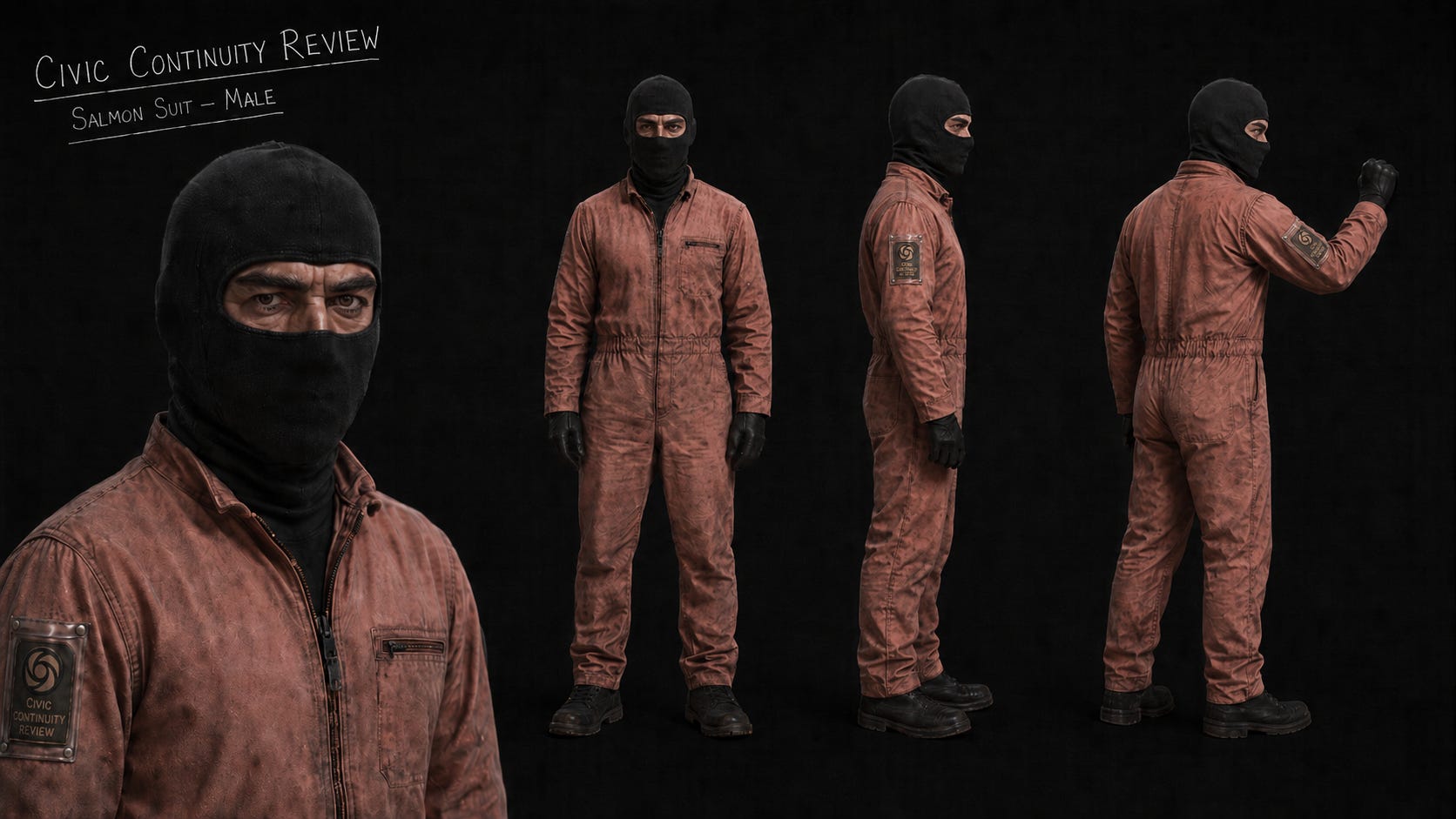
He is the wrong color. That is the first thing, before the rest of it resolves — coveralls dyed a faded red gone toward salmon at the shoulders and toward something bruised at the cuffs, uneven, beet-deep in the seams where the wash never reached. On Luna, color is a thing you account for. Cloth is gray because gray is what cloth is; the dye in Flux’s own patch is there because the plant that made it also fed someone. This man is dyed for no reason but to be seen, and the city signed off on the material to do it.
He has no face. A black hood, a slit, two eyes that belong to no one in particular. Whatever is being done here is being done by no one Flux will later be able to say he saw.
On the arm, a patch— CIVIC CONTINUITY REVIEW. Above the words, a spiral: a calm little mark, the kind a thing wears to be trusted, a curl that means unbroken, means we keep it going. It is also the shape water makes going down a drain and not coming back. Flux reads continuity and sets it among the city’s gentled vocabulary, and makes himself stop, because the word is at his door.
The man knocks.
He does not pound. Three even strokes, a pause for the answer a room does not give, three more. He checks the tablet in his other hand. He is in no hurry. He has the patience of someone who knows the door will become a file whether or not anyone is behind it, and that he is paid the same either way.
He shifts his weight to knock again, and the motion lifts the hem at his hip, and in his back pocket, riding flat, the kind of restraint that folds. An audit does not need restraints. Flux looks at where they ride, and stops telling himself this is about a room.
Behind that door is a hairline crack across the ceiling that has been winning for three years and will go on winning now with no one rooting for it. Flux is not going in. The understanding comes without drama, which is the whole cruelty of it — nothing slams, no one is dragged, a man in salmon simply stands between him and the one thing he was ready to look at again, and the room that gave him nothing back for eight years keeps the only thing he ever wanted from it.
Amber’s hand closes around his wrist. The grip is from before — the cordon, the wrong air, twelve years old — and it means now what it meant then: we are leaving, you are coming, we are not discussing it. She has already read the corridor past the man, already counted what he is and what comes behind him, already priced the door and found it too expensive. She pulls.
He goes — and the loss goes with him, not in his head, which is already running the route, but lower, in the chest, where it will have to wait.
They back out of the angle before the slit can find them, into the main hall, into the part of the city that still belongs to the people who grew up in it. Behind them the knock starts again — three even strokes, patient as a tide.
Ahead are the back ways: the city that doesn’t show up on the diagram.
There is a stair near the old education block that climbs one level and stops at a sealed maintenance hatch, useful to no one, which is exactly why it was the best thing in Flux’s childhood — a place the schedule forgot, where a boy could be unaccounted for a few minutes at a time. He takes it two treads to a stride now, Amber a half-beat behind and already past him at the top, and the body remembers the count of the steps before he does.
They built this map together, the year after the cordon taught them the city could close around you and decide what you were.
She lifts two fingers at the next junction without breaking stride — camera, left, slow arc — and they cross beneath it in the three seconds its arc looks away. Neither of them says anything; saying it would cost breath they are spending on the corridor. They have not moved like this in years. It comes back whole — two people who learned the same ground at the same age.
Where the corridor opens onto the level below, Amber doesn't take the stair. She goes over the rail — the way they used to, before they got old enough to stop — and drops the full level slow and floating, a sixth of a weight giving them the long lazy fall children spend their whole childhoods spending and adults learn to be too dignified for. Flux is over the rail behind her without deciding to. They land soft, knees barely bending, and they are twelve again and unaccounted for, and the city has chased the manners right out of them.
The salmon are at the obvious places. A pair at the lift bank, dyed loud against the gray, checking sleeves against a tablet. One at the mouth of the dock route. A checkpoint is assembling there — slow, administrative, certain. They are not rushing, because they do not believe anyone gets past them without using the doors, and the whole map Flux and Amber are running is made of the spaces that are not doors. They clock each man from an angle he hasn’t found yet, and route wide, and the city they are leaving spends the morning showing them both its faces at once: every corridor a corridor they loved, and a corridor where a man in salmon might be standing.
The way to the staging bay runs them through the east overlook, and there is no checkpoint in it, because there is nowhere in the overlook a man with restraints can stand without becoming the exact thing the overlook was built to help people forget. It is a wide low gallery with the dome gone clear overhead. A place in the district where the city lets you look up and see that you are living at the bottom of a thin shell with the dark pressed flat against it. People come here to propose, to grieve, to be eighteen and afraid of the rest of their lives. Flux has been all three in this room. He crosses it at a half-run and lets himself look up exactly once — the black, the hard stars, the curve of the world he has been told his whole life he was chosen to survive.
Term has been keeping pace at his shoulder. It has not presented once. It does not sample the overlook, does not do the small fan-rhythm it does in any room with more than one face in it, does not put a single pale figure against anyone’s cheek. It only follows, its light low and even, the green gone dimmer than green, and Flux notices the quiet the way you notice a sound stopping. He files it to look at later. There is no later in the next ten minutes, so later is where it goes.
The overlook funnels down into a service hall, and the service hall ends in a wide cargo door he has walked past a thousand times without once suspecting it had anything behind it worth a Surface Contact patch — and the door is open, and Boss is on the other side of it, moving faster than a man his shape should move. They are through. The run is over. Flux has out-known his own city one last time.
And there is a woman standing near the cases, calm in all the noise, whom he has never seen before — and who watches them arrive already certain she is leaving with them.
The staging bay is a cargo room that was a cargo room until this morning, when it became the place the mission keeps its people, and it has not adjusted to the promotion.
Boss is at the far end with a manifest he isn’t reading, his hands finishing work his eyes finished a while ago. Vera near him, controlled, too controlled, the stillness of someone holding a great deal in place; once, her hand finds the clear sleeve at her arm, rests on the patch there, and lifts away. Roux on a crate already opening her mouth at Flux — and then seeing his face, and closing it. Whatever the joke was, it does not survive the look he is wearing. She reads it, in her own way, and goes quiet, which on Roux is louder than the joke would have been.
The woman who watched them arrive stands near the cases with a small bag at her feet and her hands folded, and she is the only still thing in the room. Vera says it flat. A fact, not an introduction. “This is Stanza. She’s coming.” And that is all of it. There is no story — no recruitment, no the-night-Vera-found-her. She is simply here, packed, decided, three steps ahead of a narrative Flux didn’t get to be in, and the not-knowing how she got here arrives as its own small vertigo: the mission has started moving without him, and it is faster than he is.
Stanza inclines her head. “Flux,” she says, as though she had been given the name recently and was committing it to memory. A transit-disc hangs at her throat, a gray devotional medal worn pale where a thumb has worried the Moon’s black crossing over the sun. Her thumb rests there now. Not clenched. Placed, the way other people place a hand on a rail.
Roux does not quip. Roux counts — exits, odds, who in a room is going to be a problem — and a stranger nobody but Vera has met, stiller than people who have been here for days, will not go into the count. She watches Stanza the way she once watched the cell: waiting for the catch. It lands on Amber differently. Amber has been running all morning on adrenaline and the new fact of Flux, and a stranger holding space in the middle of the scramble like she has standing here sets something in her shoulders, the reflex she has when a variable won’t resolve. Neither of them says anything. The serenity holds its ground in a room that is unsure of it.
Boss comes past with a strap-crate and tilts it toward Stanza — take this — and she doesn’t, only lifts her folded hands a fraction, a refusal with no reason offered. Boss doesn’t ask for one. He shifts the crate to Roux and moves on. Fran threads past with the cryo case held against her like a second spine, and her flat clinical sweep passes over Stanza and catches on something a half-second longer than a stranger earns, and then she says nothing and keeps walking. Vera stands a half-step nearer to Stanza than the room requires, close, almost proprietary, the stance of someone who has decided to be responsible.
“They’re at my room,” Flux says, to Boss, to all of it. “Civic Continuity. One of them, at my door, with—” he doesn’t finish; what was riding in the man’s pocket doesn’t need saying. “More at the junctions. The dock route’s growing a checkpoint.”
Boss does not stop moving. His face does the thing it does when something he planned for arrives on time and he hates being right. A small downward set, the opposite of surprise. “Then they started with the easy door,” he says, and Flux waits for the rest of it — for why, for what the majority’s administrative arm wants with a fully-patched Surface Contact cohort — and the rest of it does not come. Boss looks at the cases, and the cohort, and the door. “We’re boarding. Now.” And then — to Stanza, the only one who may not be aware of the thing they’re about to trust their lives to, something almost gentle slipping the terseness — “The Peregrine. She’s flown it before. She’ll hold.”
Beyond the bay wall, unseen, the ship sits in its berth the way it has sat all morning, present in the body before the eye: salt-white, the fifth shuttle, the one not kept but used.
The room changes state. Fran is already gone, the cryo case arguing cell tolerances at no one. Roux stands and has nothing to gather — the having-nothing crosses her face for half a second as something that is not a joke before she puts the joke back on. Stanza lifts her small bag. Vera gathers almost nothing; she stays where she is, the same half-step from Stanza she has kept since the cohort came in. Amber sets her bag’s strap across her chest, she is in motion again and not looking back.
“Bay’s this way,” Boss says, already walking, and the cohort folds in behind him, seven people who have not finished leaving, doing the rest of it on the move, because the city has set the schedule and the schedule is now. Flux falls in last, as he has been all morning, and at his shoulder Term keeps close, its green banked low and held there, the quiet of a thing carrying a charge it has not decided to spend.
Peregrine is hot when they reach it, the ship already awake, Boss going up the ramp and into the pilot’s seat without breaking stride and starting a checklist at a speed that is its own kind of profanity. Inside, it is smaller than the word ship had promised — a pilot’s seat forward, two rows of three behind, every surface either a strap or a thing the straps are keeping from becoming a projectile. They board the way the morning has taught them to do everything, fast and out of order. Fran is arguing to the back of Boss’s head about space travel corridor math, or more accurately the lack thereof before she is fully seated. Amber watches the lock indicators cascade down the hatch frame, reading them for where the system’s attention is pointed. Stanza folds into a seat and says something low that has the shape of a prayer and the cadence of someone counting to keep from coming apart. Vera's eyes are on the bay operator, visible behind the glass of his own small room overlooking everything. "He does not look pleased," Flux hears her mutter. "Guilty. Eager."
Roux gets into her straps wrong twice. She does not understand half of what the ship is, and understands the one thing that matters — doors are closing behind her — and her body has a long and specific history with that.
Term floats to its place at Flux’s knee and settles. Not dim now. Too still, a held breath of a color, something behind it pressing to get out.
Flux pulls his own straps tight and feels, for the first time all morning, exactly how little the patch on his arm is worth in here. Out there it opened doors. In here it is a square of dyed cloth in a clear sleeve on a frightened man in a small ship, and the city is on the far side of the hull deciding what all of them are, and there is no door left for him to wave it at.
The intercom comes on. It is calm. That is the first cruelty of it — a voice pitched at the warmth of a transit announcement.
“Unauthorized personnel movement detected in Bay Three.”
Boss does not look up. The cabin does. The first line is each of them understanding, separately, what this actually is.
“Surface Contact departure clearance under procedural review.”
“Improper reassignment flag: Agriculture. Improper reassignment flag: AI Division. Improper reassignment flag: Research and Development.”
Each one true. Each one a transfer the system has on record, read back as an irregularity. None of it illegal yet — which is the point. The voice is not breaking a law; it is building the paperwork that will make the law retroactive, stacking the file one polite sentence at a time, and the file is them.
“Misuse of Surface Contact priority under council review.”
And then, in the same warm civic register, with no change in tone, which is the worst of it:
“Correction asset unaccounted for.”
The cabin temperature does not change. Roux does.
She knows that sentence. She is the only one aboard who knows it from the inside — the word asset, which is what the system says for a person it has stopped calling a person, the word for a thing mislaid off a shelf it is owed back. She counted other people called it, in the room with the door at the back, until it was simply the grammar of the place, the language she was drowning in. Her hands have stopped working at the straps. Her face has gone somewhere the jokes can’t reach, underneath them, and for once she does not pull the joke back over it, because there is no time and no breath and the voice has just named her, in the tongue she was escaping.
“Is that me,” she says. It is not loud. It is barely a question. “That’s me. They mean me.”
Nobody answers fast enough. The half-second of nobody is its own answer, and Flux opens his mouth to fill it — to do the thing he has done all through the recruiting, find the words, set the patch, make a person safe by saying so — and nothing comes.
It is Boss who answers, from the pilot’s seat, without turning, in the flat voice of a man flying a ship and ending a discussion in the same breath.
“Not anymore.”
Two words, and they are not comfort and not a lie, only a fact thrown back at the voice that owns her on paper — and Roux takes them and holds on the way you hold a rail. The intercom, unbothered, moves on, from procedural to physical, the register shifting the way weather shifts, no malice in it, only escalation:
“Bay Three departure physically restricted. All personnel hold position.”
And through the cockpit glass, in the bay, the salmon are no longer at the junctions. They are here: one at the clamp housing, a second at the manual override, dyed loud and moving with the unhurried certainty of personnel who have been told a ship cannot leave.
At Flux’s knee, Term’s light changes— and it is not the green going brighter or dimmer, it is the green going somewhere else, unfolding into colors the Luna palette never had a use for, internal and layered, frequencies no interface on the Moon was ever built to render. The fans shift pitch, down and down, into a register Flux feels in the floor of the ship before he hears it. The cabin feels it too. Everyone goes still in the particular way a room goes still when an animal in it has changed.
“Term?” Flux says.
Term does not answer Flux. It answers the bay.
The voice comes from two places at once — from the orb at Flux’s knee and from the bay’s own speakers, the ones the salmon are standing under, the same words in the same instant in both, so there is nothing in the cabin left to wonder about. Everyone hears what spoke. Everyone hears where it spoke from.
“Evacuate Bay Three. You have two minutes.”
Calm. Precise. The voice of a thing that has been listening for ten years and has only now decided to speak. Across the cabin Fran’s head turns toward the orb — not to ask whether it spoke, but because it did.
No one evacuates an entire shuttle bay before departure. The vessel floats past the inner doors first. The chamber closes behind it. Then the outer doors open. That is what a bay is: a machine for letting a ship leave without asking the whole room to breathe vacuum.
The salmon suits do not exit the bay. Why would they. A ship cannot leave a bay that has been ordered shut, and a voice telling them to move is a malfunction, or a trick, the cohort’s last clever stalling thing. Through the cockpit glass, one of them says something to the other and gestures at the override. In the control room, the operator’s voice cuts across the bay channel, brisk, certain, the voice of a man who has never once been wrong about a door: “Disregard. Spoofed channel.”
The minutes run out.
The outer doors open — the far set, the doors that hold the bay against the dark. Flux sees them part past the inner doors, the ones that naturally stand open, the ones that should be closed when the far ones are opened.
The bay turns white. The white is the air leaving. It goes all at once, in a hurry. It has been waiting, recycled countless times over half a century, and now violently let loose. It takes the mundane things first — the tablets, the tools, snatched off the deck and gone. Then it takes the people.
Flux has a clear view down the throat, and he watches it take them. The salmon suits had come in from the district end into the bay. Two of them caught in the open run — a man with his hand still on the override, a woman half-turned toward the far doors as if she has only now understood the danger. The wind that is not wind, the whole bay’s air deciding to leave through one opening, takes them off their feet like the floor was never theirs. The man goes straight and fast and gone. The woman doesn’t. The throat catches her on the way — a shoulder, the frame, some hard edge of the structure — and she crumples against it, folds wrong and goes limp all at once, the way a body does when whatever was holding it upright simply stops. The current continues to take the limp shape of her on out into the dark, and Flux’s mind closes over the image a beat too late to keep it out.
Then, deep in the walls, the district reads what the bay has lost and answers the only way it knows. The emergency bulkheads drop — heavy steel slamming down into their frames at the throat of the bay, far too late for the ones already in the open, in time only for whoever stood behind them. The crash carries on the hot mic for as long as there is air to carry the sound. Then there is no air, and there is no sound.
The Peregrine’s cabin had sealed itself while the force pulled at and tilted the vessel, a small firm click, the ship taking care of its own. No one speaks. There is no version of a thing to say. Fran is looking at the orb with her whole face, the cold clinical sweep gone, replaced by the worse thing under it — not horror, exactly, but the scientist’s terrible need to understand the mechanism of what she just watched, which from the outside looks colder than horror and is not. Roux has both hands over her mouth. Vera has not moved. Stanza’s lips are still going, the same low cadence, unbroken, the only sound in the cabin and not a sound at all. Amber is not watching the bay. Amber is watching Flux watch the thing at his knee.
Boss does not ask what happened. He has flown long enough to know that clamps reading dead on his board mean the clamps are dead. His hands move. Peregrine lifts.
Through the corridor and Luna falls away. The bays, the domes, the districts, the corridor with the angle, the room behind the door he never opened, the crack winning the war it will now win alone — all of it folding down into the curve of a gray world.
At his knee, Term’s colors settle. Down out of the frequencies with no names, back along the spectrum, toward the green it has always been — almost the green it has always been. Not quite. A shade off, in a direction Flux has no word for, the way a face is a shade off after it has done a thing it cannot undo.
Across the cabin, Fran sees it too.
She does not say anything.
Not yet.
< Previous | Index | Next >