Transit
E4 Roux

< Previous | Index | Next >
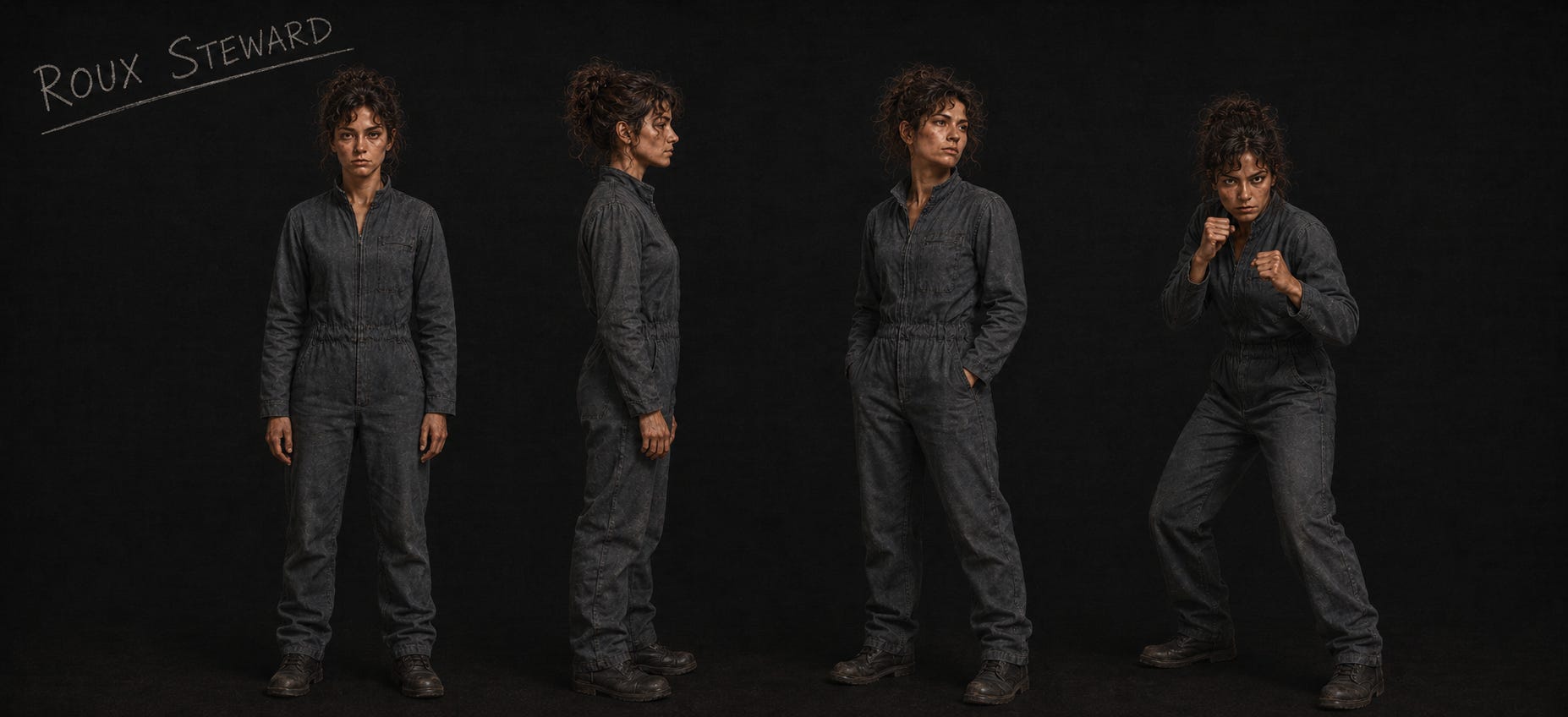
Concept Art:
He will not remember the supervisor’s name. He will remember the line of her shoulders — set the way shoulders set when a person is explaining something that does not need explaining except that the room requires it — and that she does not look up when he comes in, because the Agriculture second ring has a door that opens for Surface Contact priority and she has decided what that means before she has seen who is wearing it.
Vera stands in front of the planting calendar with her hands folded behind her back. The posture is the one from the exam hall and the placement queue: controlled stillness that obeys for reasons that have nothing to do with agreement. Her Agriculture patch sits in the clear sleeve pinned to her arm, ochre rows behind plastic, prestigious, clean, the shape of a life her family could have learned to say proudly. She has not been given a station. She has been given a reprimand, and she is letting it happen to her the way you let a system cycle.
“—absence during the onboarding window is not a scheduling problem, Herring. It is a continuity problem. The second ring runs because every hand is where it is supposed to be when it is supposed to be there. Your hand was not.” The supervisor’s voice is tired and it is not cruel and it is not wrong. The rows are real. The hundred thousand mouths are real, give or take whatever number people have started not saying. “The nutrient schedule does not pause because a graduate is processing disappointment.”
“Surface Contact priority,” Flux says, from the door.
He does not enter so much as appear in it, Term lifting at his hip, the olive branch on his arm catching the lamp-cycle and holding it. The supervisor looks at the patch before she looks at his face. Everyone looks at the patch first; he has learned this in a single morning and it has not stopped being strange.
“This is an Agriculture onboarding session,” she says.
“Yes.” The word is true and has nowhere to go.
“I need Herring.”
The supervisor’s thumb moves once against her tablet. “Is there a transfer notice?”
“Not yet.”
“A written request.”
“Pending.”
“From whom?”
He thinks of Boss leaning against the dragged-in table, tired past politeness. He thinks of the Peregrine beyond the dock glass, salt-white, the fifth shuttle not kept but used. He thinks of a name on a manifest and a door that accepted his sleeve.
“Surface Contact,” he says again.
The words are not large. They do not raise their voice. But something in the room reorients around them the way people reorient around a seal leak before the alarm has decided to become official. The supervisor holds the answer one breath too long, and then she does what everyone has done all day when the patch arrives ahead of him. She yields. She enters something into the tablet with a pressure that makes the casing click.
“Herring. Released to Surface Contact pending confirmation. Your absence remains logged.” A beat, around which there are many endings and no safe one. “If this is irregular—”
She does not finish it. Flux steps aside. Vera crosses the rail gate, and as she comes level with him her eyes drop to his sleeve and stay there a half-beat too long to be about anything but the patch.
“You’re using it,” she says. Low. Not a question.
“It’s authorized.”
She looks at him then — the full look, the one she spent five years not spending — and she does not finish the thought. She sets it aside — he can see her do it, the small internal motion of putting a true thing where she can find it later.
They walk out under the banners that have not come down. Term lifts and follows. It is not liberation. He knows that. It is defection, and the only thing making it look like rescue is the patch.
In the corridor she wants the truth, and he means to give her more of it than he has given anyone all morning.
“What did Boss tell you?”
“Enough to know I’m doing it wrong.” He keeps walking, then makes himself slow, because she has earned better than the back of his head. “Boss gave me one lead. One name. We pull her out of Correction first — that’s the official part.” The word official sits oddly in his mouth, a borrowed coat. “I’m not arresting anybody, Vera. I’m recruiting. Pulling people out. Saving them, if they want it — that’s the part that’s clean. They get to want it.”
“And the part that isn’t.”
She never misses the seam. “There’s weird stuff,” he says, and hears how thin that lands, and has no better word, which is the whole problem. “About what it costs. What we’d be going down there to do. I’ve heard it once, fast, from a man who tells the surface in pieces that don’t fit, and every time I try to put it in my own mouth it comes out like a threat instead of an ask.” He stops himself. “I can’t say it right yet. And I’m not handing you a door and letting that piece fall out sideways in a Correction corridor.”
The name of the place does something to her face — recognition of a category. “Correction.” Flat. “Who’s in there worth the official slot.”
“A ward. High aptitude — the kind of body a colony’s built on, Boss said. Routed to Intake like a wrench dropped down a drain.” He hears himself use Boss’s words and does not entirely trust them. “Her name’s Roux. And the clock on her isn’t hers. It’s the room’s.”
“It would be.” Vera says it the way you state a fact about machinery. “Correction isn’t where Luna punishes people. It’s where it stops counting them.” She is already eyeing the corridor’s mouth, the place where the signage thins. “I can’t go in with you. Misrouted civilians near Intake get held pending review — step too far in without the right identifier and the system starts processing you too. Days, sometimes.” No heat. A structural fact, the way you’d say a sealed door doesn’t open from the wrong side.
“Then don’t wait here.” He hears, as he says it, how thin the whole plan had been — Vera at the warning line, holding still in a Correction corridor on a workday, posted nowhere, going nowhere. Stillness is the one thing a Lunan body cannot afford to be caught doing. He had been about to ask her to stand in the exact posture the city files people for.
“There’s a seat. Where you wanted one.” He does not reach for the pocket this time. “But it costs something, and not the part you’d think. I’m not handing it to you until you know what.”
She takes it in. She has not once asked what the mission is, and he understands only now that the question under her face is older and worse and not about the work. Is this a door, or the kind of door that opens for him and seals on me. She has been too often on the wrong side of that exact mechanism.
“Then come tell me properly,” she says.
And she gives him where she lives — not a place to meet, where she lives. A habitation code, dome and spoke and door, flat and fast the way you give coordinates, except it is the opposite of coordinates: it is the one address in the city she has the most reason not to hand a man carrying a pocket full of doors. “My father’s there,” she adds, in the same flat voice, and it is information and it is a fence in one breath.
He files it. It does not file like the others he has taken today. It files like a weight he is now responsible for.
And then the rest of what he has just promised arrives, and he almost laughs, the wrong kind of laugh — because properly now means saying the unsayable thing in her father’s home, with her father in it.
“Great,” he says, mostly to himself. “In front of your dad.”
“Don’t make me wait long.” With teeth.
She goes.
Civic Correction does not announce itself. The corridor narrows the way Luna narrows toward whatever it would rather not examine — signage thinning to a single black access plate, the food-warmth of the upper rings giving over to the flat recycled nothing of a place built to hold and not to keep.
The clerk at the outer desk has a cup at her elbow and eyes that have forgotten surprise. She looks at the patch, at Term, and does not stand.
“This isn’t an access route. Even for the new Surface Contact greenie.”
“I’m here for one of yours. Roux.”
“You have an extra patch? She can’t leave without one.”
“I do.”
She pauses, locates the basket of the transparent modular patch holders, grabs one, and slides it through the slot. “She will need one of these. Don’t leave Intake with anyone staff hasn’t confirmed. Don’t take a verbal claim for an identity. Men’s intake is the far corridor on the right. Women’s is on the left.” She watches him take the holder, and something in her face eases that has nothing to do with the warnings she has just recited. People reach her desk on the way to the back. This one came in the front and means to leave by it, with someone. She does not let herself look at why that is rare. She takes the small thing where she can get it.
The inner panel reads his sleeve and acquiesces, and the partition takes him in with less ceremony than the archive door had, days ago. That is worse. The archive door had seemed to know it was hurting someone. This one has done it too many times to notice.
Inside, the light is brighter than light needs to be — no shadows, no corners to misread, no mercy for a face that would like to arrange itself in private. The guard who meets him wears a warm gray and the slow eyes of a man who has learned not to spend attention before it pays. He looks at the empty plastic holder, the olive branch, the orb.
“File number?”
“No.”
“Course not.” He does not move toward the cell so much as let Flux understand he will not be helped past this point. “Whoever you sign for, sign. Correction doesn’t keep a record of who you thought you were saving.”
The cell holds women in intake gray with the patches taken off them. Without the patch they are not Agriculture or Maintenance or Faith. They are cases. A person stripped of the patch looks unfinished in a way Flux has never let himself notice, and he notices it now, all at once, the way you notice cold. He counts before he means to — seven, then nine, then ten as the room rearranges itself around the new thing at the door.
“Roux,” he says. Not loud. The name does what names do in a room where the only currency is what you can convince someone you are.
A woman on the near bench is up before the sound has finished. “That’s me.” Older than the file in his head, harder used, and certain — certain the way the supervisors were never certain, the way only a person who has rehearsed a thing in the dark can be. “I’m Roux.”
“I’m Roux.” Another, from a middle bunk, dry, already half a joke.
And then a third, without the reach in it — a young one, marked along one cheek by a knuckle or the wall’s opinion, who says it the way you say a thing you do not expect to be believed. “No. I’m Roux.”
For one beat it is almost funny. The room tests the joke against its teeth to see whether it is survivable. Then the beat ends, because three women want the same door and only the door is real.
Flux looks at them and does the thing he has done all morning without once knowing it was a thing. He has walked this city on certainty — a patch, a flat true sentence, the nerve not to blink — and watched supervisors yield to it, clerks yield to it, the outer door of a holding cell yield to it. He reaches now for the one who sounds the surest. The first one. The one who said that’s me as if it had never been in question.
“You,” he says. “Come on.”
She comes. She does not hurry and she does not look back at the bench, and the not-looking-back is a discipline he reads as composure because composure is what he wants to find. The young one with the marked cheek says nothing. He files her face under later and does not yet know he will keep it.
They are at the partition when the guard moves — not for Flux, never for Flux. He had a task today that has nothing to do with a man in a Surface Contact patch, and the task was to take this woman for processing, and now the task is walking out the door on someone else’s paperwork.
“That’s not Roux,” he says, the way you correct a manifest. “That’s Wanda.”
The woman goes still.
That is the part Flux will keep. Not the lie and not its collapse — the stillness. The whole rehearsed certainty going out of her at once, like a current dropped. She had known. She had known the door was not hers and reached for it anyway, because there was nothing else in the room left to reach for, and the guard had been coming for her the entire time she stood at the front of the cell sounding sure.
The name moves through him a half-second behind and snags on something — a warning module half-watched, a face the telecasts wore for a while and then stopped wearing. Dome Two. He cannot assemble it and does not try. The assembling is not the horror. The horror is smaller.
“Wanda. This way.”
No destination. No raised voice. He does not return her to the cell. She looks once at the door Flux still wants, and she does not argue, and the not-arguing is the loudest thing in the room and makes no sound at all. The cell knows where this way goes. Flux works it out last. The guard is not cruel. He is relieved — there will be no scene to make in front of the others. Wanda goes through the inner door. It seals with the soft pressure-click of a mechanism that has been doing this for fifty years without once being asked to apologize.
He turns back to the cell with his pulse somewhere he has no file for.
The young one is on her feet. She has not moved toward the front — not now, not before. She watches him with the flat attention of someone who has spent a short life measuring exits and has just seen the nearest one open for the wrong person and close.
“I’m Roux,” she says. Again. Plain, the same way she said it into the noise, when plain was not loud enough to be believed. Her voice does not do the thing she wants it to at the end.
He hears, this time, what he did not hear the first time. Not certainty — he knows now that certainty is the cheapest thing in the room. The truth. It had been standing on a middle bunk saying so while he walked out with the performance.
“You’re the real one.”
“I’m the one they were going to process.” She does not soften it. “Whether I’m real depends on where that door goes.”
“Down,” he says. “Earth.”
Something crosses her face that no department gets to see. Not hope — hope was not an instrument she was ever issued. Arithmetic. Down against here, and here is a room with a door at the back that opens for women who are told they will not need their things.
He takes a patch from his pocket, places it inside the transparent holder, and hands it over. Ochre, moth-silk catching the bad light. She looks at it the way you look at an object that should not be in this room.
Her fingers close on it. Then she brings it to her chest and holds it there a moment.
She pins the olive branch onto intake gray. It sits badly, too good for the fabric. She looks down at it once. Then she looks at the women in the room who heard down, Earth and were not handed a door, and the thing in her face is not triumph.
“They took three since I’ve been here.” Flat. Inventory, not confession. “At night. First one left her cup. Second one left hers too. Third one fought, so everyone woke up.” A beat she does not get all the way across. “Staff said they wouldn’t need their things.”
The sentence enters the bright room without timing and changes the air in it. Flux looks at the bench — ten, then nine when she stands the rest of the way — numbers doing the only thing numbers do, a column that adds and never explains.
Roux goes ahead of him through the partition without being told which way, already counting the corridor — exits, angles, who is watching whom — and he follows the one who told the truth out past the bright unmerciful light, carrying the thing he has no file for: that he has spent all day opening this city with certainty, and certainty had just reached for the wrong woman. The clerk at the entrance scans their patches and they cross the threshold.
The habitation is third spoke, dome four — older glass gone slightly opaque with decades of being breathed on, so the corridor light comes through the panels like light through river ice. Roux reads the door before they reach it: the seams, the lock-type, where a person inside would stand. She has not stopped counting exits since the cell, and he is beginning to understand she never will. The patch on her arm still sits too good for that color gray.
The door opens before he can decide how to knock.
The man who opens it is neither old nor young. His face was built by laughter — the lines around the eyes were cut by it, years of it — and then something taught the rest of it to keep still, and now the two live together on him: the creases of a man who was happy, holding a stillness that came later and stayed. He looks at the patch. Everyone looks at the patch first, all day, and the man does it too. And then he does the thing no one has done since the morning began: he looks at it, and his face does not change, and he is not afraid of it. The orb at Flux’s hip, the rare green light of it that has made clerks sit up straighter — the man takes it in and is unmoved. He has already buried someone over the place this patch opened toward once before. It is not a key here. It is a headstone Flux is wearing on his arm.
“You’re the one with the seat,” he says. Not a question. Vera has been home.
Inside, two cups on the table. One is his. The other has been used and set down and not cleared, and it is the kind everyone is issued, dull reclaimed metal, indistinguishable from ten thousand others except that it is here, and faintly warm, and no one is sitting in front of it. Vera does not look at it. Flux clocks it the way he clocks everything — a second cup, a presence the room is built around — and files it under not-his-business, because the man’s flat eyes have already told him which questions this house does not take.
Vera stands by the inner partition in slate gray, the patch still in its sleeve on her arm, with the look of someone who has been having an argument that used no words and lost none of it.
“Tell him,” she says. To Flux. “The part you said you couldn’t say in a corridor. Say it here.”
So he says it, in the man’s home, with the man in it, the way he swore he would and dreaded he would.
He tries to build it gently and it will not go up gently. There is a place on Earth that came through, he says — not the city’s story, a real one, people, near a coast. They asked for colonists. They want it to last, which means they want people who can stay. Permanently. Likely for good. And they have asked — here is the word that turns sideways in his mouth — they have asked for the colony to grow. From the ones who go down.
Something stirs in the next room and stops. A small domestic motion arrested before it finishes. It lasts less than a breath. The father does not look toward it. Vera does not look toward it. Flux notices it and loses it and files it under the house’s business, because he has more wrong words left to get through.
“It’s an ask,” he says, and hears how badly he needs that to be true. “Not an order. You can say no to that part and keep the seat. Nobody’s being shipped down to —” He cannot find the end of the sentence that doesn’t sound exactly like the thing he is promising it isn’t.
“To breed.” Roux, from the doorway. The first whole sentence she has spent on her own since the cell, dry, the edge back in it now that there is a wall at her back and a patch on her arm. “That’s the word he’s walking circles around. He’s trying to tell you it’s polite.”
“Is it polite?” the father says to Flux. The first thing he has asked.
“It’s a choice or it isn’t.” Vera answers before Flux can, and her voice has the exam-hall flatness, except now it is pointed and it is hers. “If I can refuse the second part and still keep the seat, it’s a choice. If the seat quietly disappears when I say no, then it was never an ask, it was a price — and he doesn’t yet know which one he’s carrying down in his pocket.” She looks at Flux. “Do you?”
“I like her,” Roux says, to no one, the way you note weather.
He thinks of Boss, tired past politeness, telling him about the surface in pieces that don’t fit. He does not know.
“Not yet.” He will not pretend, in this room, to a thing he doesn’t. “And I won’t swear I’ll find out in time — I might not, and then you’d have caught me lying in your own father’s house.” The truer, smaller thing, then: “But your no costs me before it ever costs you. Somebody moves to pull your seat over it, they pull it through me — loud, where you get to watch whether I win. That much I get to promise. The rest I don’t.”
The father is quiet a long moment, looking at his daughter, not at the patch at all anymore. When he speaks it is not about the mission.
“Your mother went down on the first attempt. A coast, years ago.” Quiet. “The whole thing failed — and I cannot understand how they are standing here asking again. We were going to follow her, once it settled. It never settled. We never went.” A look at his daughter. “You have wanted that chance your whole life. I always knew you’d take it the day one came.” Then, not an argument, its opposite: “I told her not to go. I was right. Being right has not helped me a single day since. So if you’re going — go knowing somebody gave you the truth of it.” A look at Flux. “That’s more than she got.”
Vera reaches up and works the Agriculture patch out of its sleeve. The ochre rows, the prestige, the life her family could have learned to say proudly. She does not crumple it or set it down with weight. She just takes it off. Flux puts an olive branch in her hand and she seats it where the rows were, in front of her father, and it sits there too good for the gray — the same wrongness Roux’s wore in the cell — and the father watches her do it and does not stop her, and the not-stopping costs him something with edges Flux cannot find.
Then he opens the door. His own door, outward, for his daughter to leave by — the exact motion the city’s doors made for Flux all day, except this one is made by a man who gets nothing for making it, who is letting the surface take a second person he loves, and who opens it anyway because the thing that would keep her is the machine that counts grams and schedules corrections.
“Don’t make me wait long,” Vera says to him — the same words she gave Flux in the corridor, except here they come out wrong at the end, because here they are a lie the two of them are agreeing to tell.
They file out past him. Flux is last through, and as he passes, the man speaks once more, low, not for the room.
“You said five more of those patches.”
“Three, now,” Flux says.
The father nods, slow, like a man writing down a number he has no pocket to keep, and says nothing else. Flux is three steps down the spoke, Term lifting at his hip, before it occurs to him that he was asked something — and by the time he reaches for what it was, the door behind them has already sealed, soft, the way every door in this city seals once it has decided about you.
He has been looked at second all day.
The patch first, then him — supervisor, clerk, the gray man at the intake desk, a whole city of eyes that sort the orb and the olive branch before they get anywhere near his face, and by the time they reach his face they have already decided what it is allowed to mean. Somewhere in the morning he stopped expecting to be seen. He started, a little, without meaning to, to be the patch.
He had sent her the message before any of it — before the patch had taught him what it did to a room. Not the mission. He had not had the mission clean yet, and even now, with it clean, he cannot get it out of his mouth without it turning into a threat. So he had not tried. He had sent her the fewest words he could muster: that there were extra patches, that they were his to grant, that she should meet after her workday if she wanted the seat next to his. It was sent through the orb at his hip the way you send anything. And then he had spent the whole day not letting himself wonder whether she would show up where he asked her to.
The junction is the last lit thing before the bulkheads — the ones that seal off Dome Seven, what is left of it, what no one reopens. The schedule board overhead cycles its pale characters into the dark over the dead dome that took both their families the year the seal failed, the year two children at school no longer had a home to return to and decided, without ever saying it aloud, that they were one thing wearing two bodies. The route, for them, runs toward the grave. There was the rowan, and the gold man, and this: the place the city made for them by sealing away their past.
And on the bench beneath the board, a bag at her feet packed small and square the way you pack when you have weighed every gram of it, is Amber.
The bag is the answer. It was the answer before he rounded the corner.
She is watching the corridor mouth — the place he will come from. She has been watching it a while; she knew the route, she always knows the route. And when he comes around into the dusky light she does the thing no one has done since before dawn.
She does not look at the patch.
She looks at him.
The posture has a sentence ready — the flat true thing, the nerve, the certainty that opened every door today — and he opens his mouth to spend it and finds there is nothing for it to do. She is already standing. The decision he half-feared he was coming to ask for is packed in a square of gray canvas at her feet, made before he turned the corner. So the sentence dies, and the thing it held up dies with it, and what is left when the posture goes is only him: tired, three doors lighter, twenty hours into being someone he has not finished becoming. He crosses the gap. She meets him in it. Neither of them says a word.
The hug is the third kind — a body that has stood at attention since dawn being told, at last, that it can stop. He puts his face where her neck meets the collar of her ash coveralls and breathes, and the breath comes out wrong-shaped, ragged at its edges, because it is the first whole one he has taken since he pinned the patch on. Her hand finds the back of his head and stays there, the way you hold a thing you have already decided you are not going to drop. Term lifts at his hip and hums its small green hum, and neither of them looks at it.
Because here is the part he cannot make sit flat, standing inside it: she had somewhere else to be. Everyone he collected today was being thrown out — denied, processed, dropped down a drain — and they took the door because the room behind them was burning. Amber’s room is not burning. AI Division, the step-ahead posting, a clean forward life the city would have been glad to let her keep. She packed a bag the size of a held breath and came and sat on a bench at the edge of the dead dome, and nothing in the world made her.
Only when she lets him go does she look at his sleeve. Not first, but now.
“Do you have mine?”
He had forgotten, somehow, that the door still has to become an object. He takes one of the folded olive branches from his pocket; two left after, the arithmetic running quiet under everything. Amber looks down at her own arm — at the geometry of AI Division, the forward track, the life that would have kept opening in front of her if she had only stayed still enough to keep deserving it.
She works it out of its sleeve carefully. Not torn, not flung. Carefully — and that is the part that lands wrong in him, because careful means it never failed her; she is only setting it down. She lays it in the bag like a thing she is keeping, not a thing she is done with. Then she takes the olive branch from his hand and seats it where the other one was. The ochre looks wrong on the ash gray for less than a second. Then it looks like it was always going to be there.
“You don’t even know what it is yet,” he says. “Where we’re going. What it costs.”
“I know you have a door.” She settles the patch flat with her thumb. “I know you sent me a side to be on and told me where to be, and I packed a bag around it. The rest I’ll take when you can say it right.”
“He can’t say it right.” Roux, dry, the edge all the way back now that she is an hour clear of the cell. “That’s been the whole problem all day, watching him not say it. So I’ll do it, since we’re all family now.” She tips her head at Amber, and it is almost gentle, the way a knife is almost gentle when it is being honest with you. “You just pinned on a one-way trip to a planet that already killed everyone who went down the first time — to meet a pile of old Mandarin army men who somehow survived it and put in a request. The polite word somebody used on me was continuity. Biological continuity.” She lets it sit. “Women, Amber. They want women. That’s the pitch.”
“It’s an ask,” Vera says — quiet, precise, the caveat she fought for in her father’s house carried over intact. “You can refuse that part and keep the seat. He swore he’d stand in front of anyone who tried to make it a price.” A beat. “We’re holding him to it.”
Amber takes the whole of it without a flicker. She looks at the olive branch on her sleeve, then at Flux, and the yes does not move — Roux’s worst version cannot reach it, because it was never resting on the mission to begin with.
“I didn’t pin it on for the planet,” she says.
“You didn’t have to,” he says — because the patch is on her now and the sentence has nowhere else to go.
“No.” Her hand finds his arm again. “That’s the whole of why I did.”
Roux looks between the two of them, and then at Vera, and something in her settles that is not quite a smile but is in the same family. “Okay,” she says, to no one, the way you note that weather has turned. “Okay. I can work with this crew.”
Vera says nothing. But there is something at the corner of her mouth that has not been there since the exam hall — the first thing near ease he has seen on her — and she is sorting the three of them, he can tell, into a different drawer than the ones she usually keeps.
Amber reads the whole day off them in about a second, the way she reads everything. “Three,” she says.
Of all the faces from this day — the supervisor, the clerks, the gray man at the desk — he will keep none. He will keep this one. The one that looked at him before it looked at what he was wearing.
“Three,” he agrees. And he cannot keep it out of his voice, the small dumb warmth of it: three doors placed in a single day. Three patches distributed, two still folded in his pocket.
Tonight there are four of them turning together toward the lift, the only color in the whole gray run of the corridor riding small and bright on their arms.
He thinks that is a lot. For the length of the walk to the lift, he lets himself think it is enough.
< Previous | Index | Next >