Transit
E3 Vera

< Previous | Index | Next >
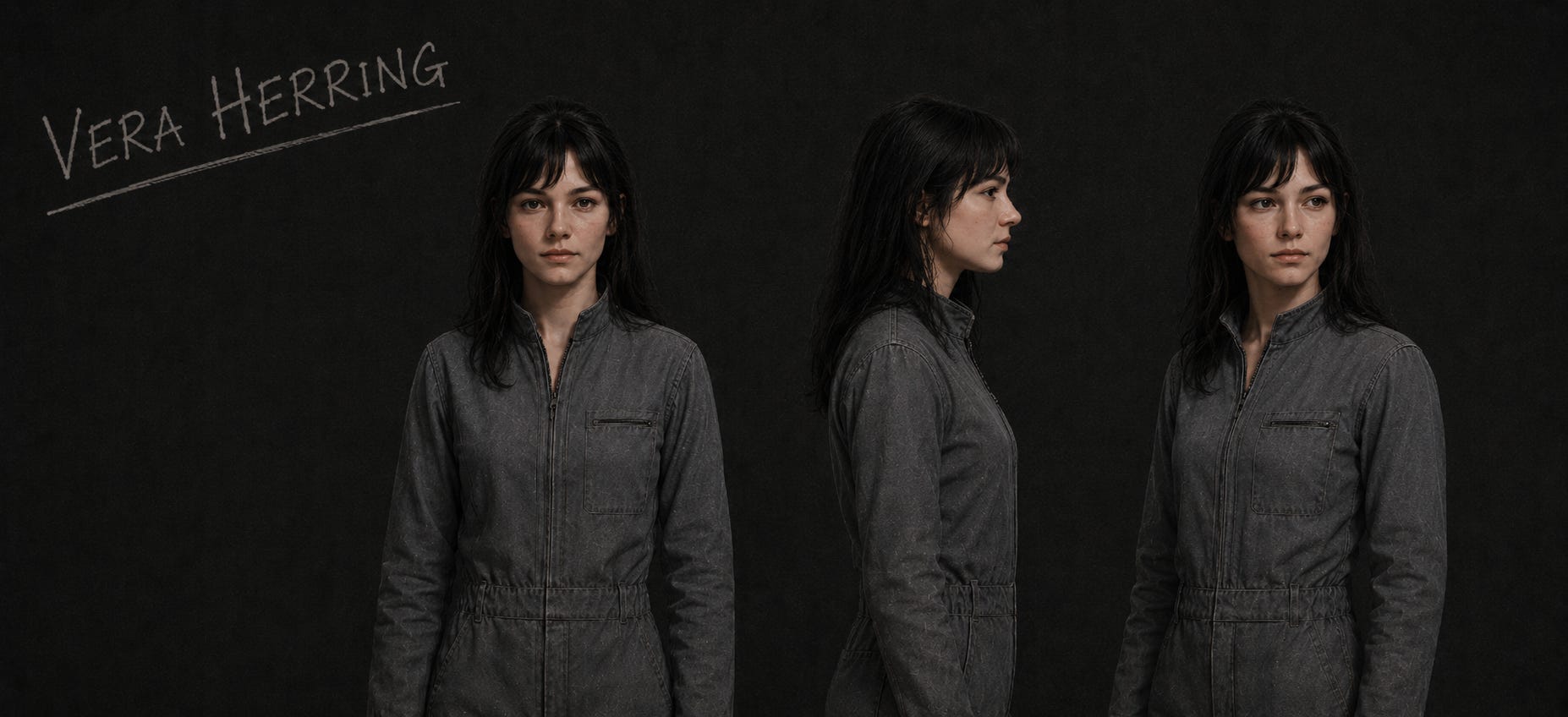
Concept Art:
The room is the right temperature. The bed is not, on the side where Amber had lain — cool to the touch, the warmth gone out of it. Thirty minutes at least. Maybe more. Luna runs its heat from the reactors below and keeps occupied rooms at 19.5 degrees; when a room goes empty the city stops spending on it. The bed had known she was gone before he did.
Flux does not lie there taking inventory of it. But the room has put itself back together in the administrative way rooms do when a person leaves early and carefully: the blanket straightened to the point of almost, a cup rinsed and inverted by the small sink, the chair returned to a position nobody returns a chair to unless they are trying not to wake someone. The room holds the shape of what left. Not well. Well enough.
He gets up before it can insist on something he does not know how to answer.
A paper-shadow from the ceremony is in the pocket of yesterday’s coveralls. He does not remember putting it there. He touches it once through the fabric and does not take it out; there is no reason to keep it except that throwing it away would require naming what kind of object it is.
Don’t let them ship you down there without a goodbye.
He recalls it once and then again. By the second he is already dressed. Term lifts from the shelf when he moves toward the door — fans at the quiet cycle, slow green, the rhythm it has held since before he knew what rhythm meant. He carries it out. The day ahead has a shape he already knows.
The posting office is smaller than the number of futures it handles.
Two counters, a recycler slot, drawers too shallow to be worth the metal of their tracks. A line of graduates runs along the wall in gray, each with a see-through plastic pouch pinned to the arm of their coveralls, where their patch will be placed. Some talk in low voices. Most do not. It is too early after placement for either celebration or grief to have learned the correct face. Flux grabs from a basket by the door the thing that will hold his division patch for the rest of his life, and gets in line.
The clerk behind the left counter has a red X obscuring her posting patch.
Not large. Not punitive the way children imagine punishment — two bands of red threads crossing an old weathered patch, her prior posting, inside the clerk’s own transparent plastic casing pinned to her standard jumpsuit, old enough that the dye has retreated into the fiber and gone almost brown at the edges. Resource-drain is the unofficial classification, though no one says it within earshot of them without a reason. Flux knows the term before he sees the mark. He knows the other words too — find an airlock — and knows both are true, that the city uses each on different people for reasons it does not publish. The worst go out the lock. Some end up here, behind a counter, kept marginally useful, very good at the one task left to them. The clerk is very good at it. Her hands know the trays and the laminate sleeves without consulting her eyes. Flux clocks the mark the way he clocks everything and then looks away, because staring would be a kind of cruelty he has not been given a reason to spend.
The tray between her hands holds the divisions in miniature. Each patch the same ochre-yellow in principle — plant dye, whatever the season’s crop gave up, which is never quite the same twice. Each patch is distinguished only by the division symbols: Agriculture’s rows, Maintenance’s wrench, Civic’s arch, Faith’s transit glyph, Science’s Erlenmeyer flask. The logos are embroidered with raised silk thread, the silkworms that produced it having spent their lives two levels below this counter. The patches are a standard size, made to move between coveralls rather than be resewn each time.
“Boron, Flux. Surface Contact track.”
She opens the tray’s narrow side compartment and removes a patch from it. An olive branch, low-visibility — good work, restrained work, expensive only if you know what had to be grown, harvested, spun, mordanted, dyed, rinsed, dried, and approved so that a quiet yellow emblem could sit on gray. He places it into the pouch he had pinned to his left arm. It weighs nothing. He feels it anyway — a cool disc the size of a small palm, the weight of a thing decided without him and for him.
Vera Herring is at the other counter.
He does not place her immediately, because she is where she has every right to be and still wrong inside it — same cohort, same exams, same tunnel ending in this room. She stands with her hands folded behind her back while the second clerk checks a tablet against the tray, and her face is quiet the way it was quiet in the exam hall: not empty, not soft, simply unavailable. The clerk gives her Agriculture — an emblem representing a set of earthy rows. A prestigious posting. Existential infrastructure. A clean future, the kind a family speaks of carefully for years because pride is allowed when it has been routed through utility.
Vera accepts it with both hands. It looks, for half a breath, like someone handing her a gift she cannot refuse without insulting the room.
Then her eyes find his arm. Not his face. The olive branch.
Something crosses her face and is gone before it becomes an expression anyone could accuse her of having. Not jealousy, not exactly. Recognition, with the door already closing — the look of a person watching a door seal that they had been standing in front of, pressing against, with someone else now on the other side.
Flux files it. He does not yet know what it means.
“Mr. Flux.” The clerk does not raise her voice. “You were issued five additional.”
His attention snaps. He does not want to be the reason the line stops. He takes the five patches from the counter without looking at them — five more olive branches, five more with the same quiet weight — and goes.
The corridor to the restricted archive has a different quiet than the posting office. Not less sound. Less permission. The floor is the same polymer, the walls the same composite, the air the same recycled sweetness moving through vents installed before anyone now living was old enough to complain about them — but the corridor narrows toward security doors with no signage except a small black access plate, Luna’s architecture knows how to make a person lower their voice without asking. His clearance is two days old. He is still getting used to doors deciding he may pass. The plate reads the olive branch on his arm and flashes green. The doors acquiesce.
He is most of the way down the next threshold when the back of his neck tightens. No alarm. No footfall out of rhythm. Nothing worth turning for, except that his body has already turned before his mind finishes objecting.
Vera is at the far end.
She stops when he stops. She has her Agriculture patch in her hand, not yet fixed to her arm, held flat between two fingers at her side. She looks at him without looking away, and for a moment her face does something almost like decision.
A soft hydraulic hiss, and the security partition cycles down between them — unhurried, sure of itself, a panel becoming a wall with the soft finality of a civic mechanism that has been doing this for fifty years without drama or apology. It takes her in sections: the line of her body, her hands still at her sides, then her face, cut off at the mouth first and then the eyes, the door coming down through the middle of whatever she had been about to let him see. The seal completes with a clean pressure-click. The lock-light goes dark.
Flux stands. He does not call out; there is nothing to call through. The door has accepted his patch and explained the rest without language. He turns back toward the archive. The feeling between his shoulders does not leave.
The archive is cold when Flux enters.
He expected a liaison. Or an agenda. Something with headings, restricted windows, approved topics, the usual civic courtesy of pretending control is instruction. Instead, a nearby terminal waits awake with a single note on its screen.
PREPARE AS YOU SEE FIT FOR MISSION BRIEFING.
No signature. No task list. No supervision.
Term’s fans tick once at his shoulder.
The Year Five through Twenty-Two cooperative-contact record is not a file.
It is a wall. That is the first useful thing his mind does with it — the index opening across the station into categories inside categories: cooperative telemetry, orbital observation, supply exchange, landing windows, hazard advisories, network traffic abstracts, human authorization remnants, discontinuation notices. Seventeen years collapsed into something with margins and permissions. A living thing made flat enough to scroll.
The first pass gives him the curriculum, only larger. Surface contact beginning Year Five. Cooperative phase. Intelligence sharing. Contact ceased Year Twenty-Two. He reads the same lines again. The second pass does not hold still.
There are acknowledgments. Thank-you statements in formats both human-written and machine-generated, formal, the way people write thank-you notes when they mean it and cannot say so. A landing-coordinate set revised after a storm changed behavior over what used to be the Gulf. A supply packet tagged for human review, delayed nine minutes, then approved.
Request permission to approach LZ-7. Granted. Approach window 14:00–18:00. Acknowledged with thanks.
And then a surface network requesting lunar confirmation before releasing a corridor map to a retrieval team, because the team contained biological personnel and the surface system would not assume acceptable risk.
Would not assume acceptable risk.
Flux sits with that sentence longer than the sentence requires.
Hostile artificial intelligence eliminated remaining human surface survivors. He has written that. Held to have been hostile. He has written that too, less than a week ago, on an exam, and liked the way it scored. The archive does not argue with the textbook. That is the worst of it. It simply sits beside it, row after row, polite and timestamped, and refuses to become the same shape. The phrase does not lie, exactly. It just does a job that is not called naming. The curriculum took seventeen years of a relationship and pressed it flat into a weather report — a date, a cessation, a change of conditions — the way you press a thing flat when you do not want anyone to feel how thick it was.
He scrolls. The rhythm thins in Year Twenty-One, the gaps between acknowledgments lengthening, requests Earth made that Luna has no record of answering. Then: Last contact: Year Twenty-Two, Day 187. Signal logged. No acknowledgment returned.
A discontinuation cluster opens, half its entries sealed past his clearance — the patch opens doors but not all the rooms behind them. Near the bottom, a line catches, not because it announces itself but because it does not belong cleanly anywhere:
ORIGIN UNATTRIBUTED — LOW-BAND SIGNAL FRAGMENT — COASTAL SOURCE PROBABLE — HUMAN STRUCTURE UNCONFIRMED. No corresponding handshake. No attachment available at this clearance.
It waited for a reply that matched, and none came. Flux copies it into his notes because that is what one does with an unmatched edge. He cannot place it. He scrolls on, and does not think about it again — not consciously, not today.
He leaves carrying a question that does not have a shape yet, which is its own kind of weight, heavier than an answer because there is nowhere to set it down.
The meal hall at mid-shift runs two streams of people crossing at the ladle stations, and the perpetual stew has been refreshed from the morning batch — thick enough to be intentional, thin enough to be honest, the same ladle giving the same measure to everyone who holds out a bowl. Sometimes the ladle finds a chunk of rabbit, and it feels like luck instead of policy. Flux’s bowl has none. He carries his tray toward the tables, and that is when the room makes a count he did not ask it to make.
Vera is across the hall, far table, near the wall.
She is not eating. Her tray sits in front of her, the stew gone to skin, a chunk of rabbit cooling untouched at the edge of the bowl — luck she has not noticed because she is spending all of herself on something else. Her spoon moves in small circles, going nowhere, the motion a hand makes when its owner has stopped tracking what the hand is for. She is angled so that keeping Flux in her vision costs her no head-turn at all, and she has been angled that way long enough that the woman beside her has tried twice to start a conversation and given up.
Patch desk. Archive corridor. Now here. Three rooms her posting did not put her in, and his recognition runs out of room to forgive the coincidence. The pattern resolves, all at once and a little too late, into a person.
He crosses the hall with his tray still half full and sits.
“You’re not at the agriculture orientation,” he says.
“I’m aware.” Even. Flat in the way that takes work.
He waits. He has learned waiting from machines — the patience of sitting in a silence until the thing you are trying to understand gives up and shows you how it works. She does not fill it. She waits in it with him, and he had not expected that, that she would know the same tool.
“We have been in the same classes for five years,” he says, “and I never saw you look at me once.”
It is out before he has weighed it and he hears the weight only after — that the sentence is not the accusation he meant it to be, that under it is the fact that he was keeping track, that you do not notice an absence for five years unless some part of you was waiting for it to end.
Her face does something small. Not surprise. The other thing — the recognition of having just been handed information she did not expect to receive.
“You noticed?”
He understands, too late, what he has admitted. “...Yes.”
She lets it sit. She does not use it. He will think about that later — that she had it in her hand and set it down.
“It’s not you,” she says. She is not being unkind. She is being accurate. Her eyes go to the patch and stay there a moment too long to be about him. “It’s the patch. The surface track. I heard the word recruits — three days ago, in the corridor outside the Sub-Seven staging office. I wasn’t supposed to be in that corridor. I was in that corridor.”
“And since then.”
She does not answer, which is an answer.
“You think I have influence,” he says, careful about what he has the right to claim.
“I think you have access.”
“That isn’t the same thing.”
“No.” She waits. And he understands then that she is not asking him to pretend it is the same thing. She is asking what he will do with the difference.
“I petitioned three times,” she says. “The first two came back denied. The third one they didn’t bother to come back at all.” Her voice drops — not quieter, denser, the way something sounds when it has been compressed. “Because the rows won’t go anywhere. Because I petitioned three times and the third one they pretended not to receive. Because the man running this came up from the coast once and they let him keep coming back, and nobody ever asked me—”
She stops.
Not the way you stop when you’re finished. The way you stop when the next word costs more than you brought with you.
“—if I’d go,” she says. Flat. A smaller sentence than the one that had been coming.
Flux files it. He does not know what he is filing. He has the sense of a tile set into a wall in the wrong place — the small wrongness of a thing that fits the space and is still not the right shape for it — and he is the only one who has noticed, and does not yet know that he has.
“If there are recruits,” she says, “say my name.”
There are several correct answers. He can feel them arranging themselves in the disciplined part of him, the part education built and Luna sharpened. I have no authority. I cannot promise. I will follow procedure. I will not misrepresent influence. They are all true.
They all sound like doors.
“I’ll see if I have any say,” Flux says.
His hand finds the pocket. Five patches, counted through the fabric without looking down. Maybe he does.
He means it. That is the trouble with it. He cannot know — sitting in the loud hall with his half-full tray — that in two hours a worn man near the dock bays will hand him more say than he has any idea what to do with, and that this sentence, said now, generously, to a person who is starving for a future, will be waiting for him on the other side of it.
Vera looks at him then. Not at the patch. For the first time since he sat down, something in her face has no administrative equivalent. It is there and gone.
She looks at her tray. The cooled broth, the fat gathering in a pale ring around the rabbit she never noticed she was lucky to have.
“I’m going to onboarding now,” she says.
“You’re late.”
“Yes.”
“Agriculture, second ring?”
She pauses just long enough for the question to become what it is. She has been skipping it all morning to do this — and somewhere a supervisor has a list with her absence on it, has begun the small machinery of correction Luna keeps oiled for exactly this kind of deviation. She will walk into it because she has decided to walk toward it. “I’ll be there.”
She stands. She leaves the tray.
Flux watches her go until the lunch crowd takes her into gray. Only after she is gone does he reach across and take the rabbit from her bowl. He holds it on his spoon for one breath — the theft of it, the waste of not taking it, the absurdity of either feeling mattering in a city where every gram has a ledger. Then he eats it. He files where she said she’d be. He has his own meeting to get to.
The walk to the docking bay is mostly downward — not literally; Luna is too efficient to waste that much slope on symbolism — but the corridors narrow toward infrastructure, and the air changes by increments: less food steam, more lubricant, warm polymer, metal dust, the sterile note of seals checked too often. The patch lets him through doors that would have remained sealed for anyone else. The olive branch rides on his arm, buttoned into its pinned plastic sleeve. The archive turns behind his eyes — and Vera’s voice turns with it. He walks toward the meeting already weighing the promise, which version of it he’ll be able to keep: forward her name, or take it back. He is not going to take it back.
Two promises now, folded somewhere beside the paper-shadow: Amber’s, unanswered, and Vera’s, made into a future he cannot see the shape of. Faster than authority. He keeps walking toward the renowned man who is about to make the imbalance worse. Term keeps pace at his hip.
The corridor bends and the wall becomes glass — a long observation strip above the bay floor. The shuttles below are identical — Year 0 hulls, retrofitted, the polymer so well-maintained it still holds the color it was cast in. They have been kept. The design is fifty years old and still correct: broad enough to find lift in an atmosphere, flat-bellied for water, dual ballast housings visible along the belly, the secondary burn geometry readable in the engine nacelles if you know what you’re looking for. Someone decided once that this was the shape a transit vessel had to be. Nobody has found a reason to argue.
The fifth is not kept. It is used.
It sits apart — salt-white along the lower seams where the others are still gray, the hull dull where theirs shine, compact and graceless in the way of something built around the idea that atmosphere is something to survive rather than admire. It looks like it has been somewhere. It looks like it intends to go again.
The staging bay is not an office. That helps and does not.
A temporary partition cuts it in half — temporary long enough to have become architecture. Cargo straps hang from wall hooks in loops stiff with age. The floor carries old fluid stains worked into its texture, where cleaning could remove the residue but not the history.
The man by the dragged-in table turns when Flux enters, and he is approximately what the stories promised and nothing like what they prepared him for.
“I’m Boss.”
He is not old — that is the first correction Flux has to make; the stories make their survivors old. He is somewhere near forty, hard to place, because Luna wears people along predictable lines and Boss has been worn by something else. His shoulders sit differently. His stance wastes effort in the wrong gravity, or saves it in one Flux does not know — feet too far apart for Luna’s floors. He wears standard coveralls that have aged through action. There is a smell around him Flux has no category for — not dock, not oil, not recycled air. Earth, maybe. The mind leaves it unnamed.
He looks at the patch before he looks at Flux’s face.
“Boron Flux.”
“Sir. Your name really is Boss, then?”
“Don’t start with that.” Flux closes his mouth. Boss’s eyes track Term for half a second too long and return. “You’re the one who used the archive today to dig into the past.”
Flux does not answer immediately.
“The archive says contact ended,” he says. “It doesn’t say what happened.”
Boss looks at him for a long moment.
“No. It wouldn’t.”
“We flipped the game board,” Boss says. “And they stopped playing with us.”
“Is that what this is?” Flux asks. “Talking to them again?”
Boss’s face does not change.
“No.”
The word lands harder than Flux expects it to.
Boss looks at the manifest under his forearm, or pretends to.
“The graduate in your class that got gobbled up by agriculture. Vera Herring.”
Flux’s hand tightens on his knee. Boss sees it.
“She petitioned three times.” A pause that is not for breath; something moves through it. “I’d have taken her. Couldn’t, for this one.” He pauses again, shorter. “She may still get her chance.”
He does not say what kind of chance. He does not say who decides when that door opens or how wide. The silence says enough — and Flux, who got the patch he never petitioned for, hears a shape he cannot quite name yet and has nowhere to set it down.
Boss glances from Flux’s patch to his pocket as if the cloth were transparent.
“You’ve got five more of those.” Something shifts in his expression. Not sympathy exactly. “I don’t envy you having to explain it to them.”
Flux does not ask what he means.
Boss leans back against the table, eyes direct now, tired past politeness.
Flux thinks of Vera’s spoon moving around the rabbit. Of the archive line marked origin unattributed. Of the security door cutting her face away before either of them could speak.
Boss sets the manifest face-down. Whatever the meeting has been building toward arrives now, in five words, in a voice with no weather in it at all.
“There are humans down there.”
< Previous | Index | Next >