Transit
E2 Amber

< Previous | Index | Next >
Concept Art:
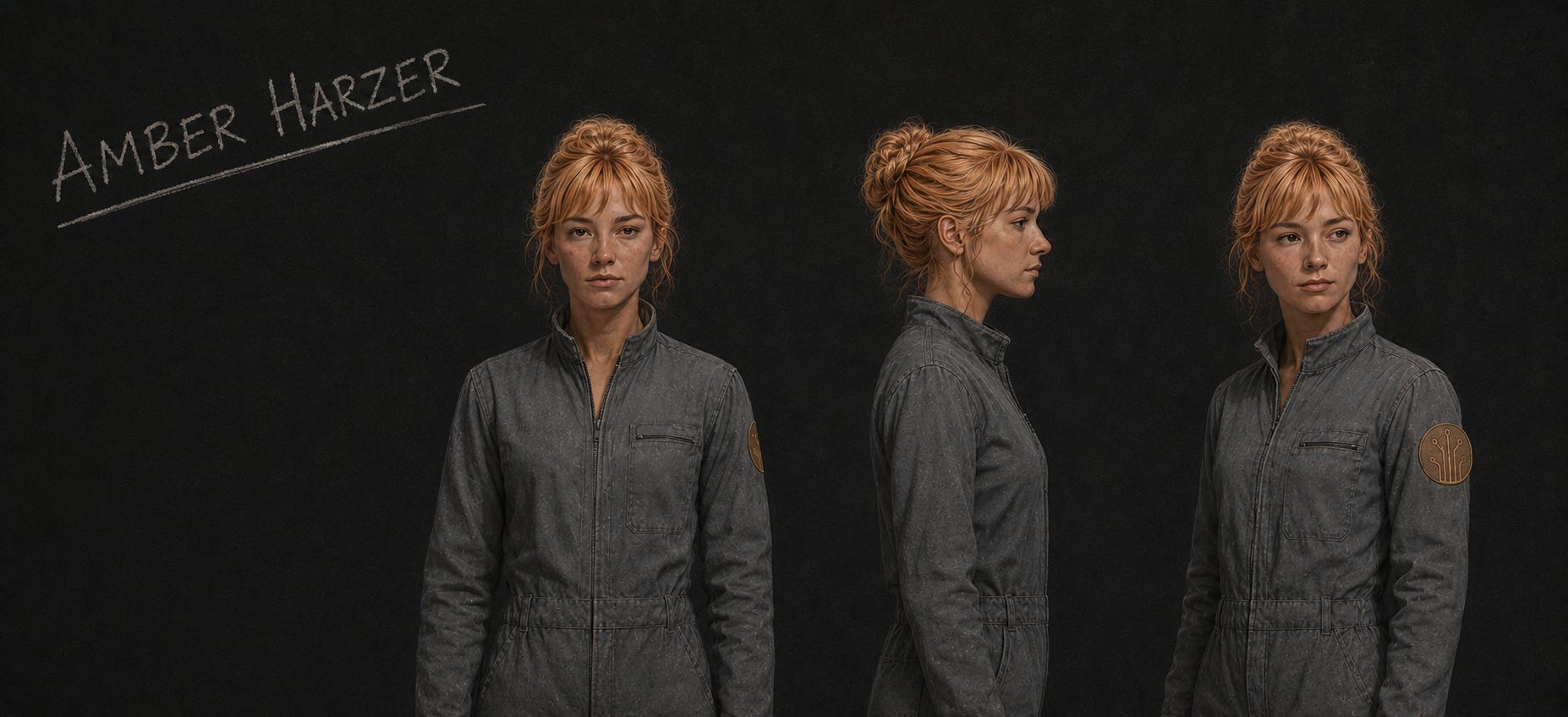
Flux wakes with the posting already sitting in him.
It has not moved in the night. That is the first thing his mind understands before the room finishes assembling around him — the gray walls, the shelf, the hairline crack across the ceiling, Term’s slow green light steady in the corner of his vision. The words are not on the screen anymore. Term went dark after he read them for the fourth time, then the fifth, then stopped counting because counting had started to feel like a form of argument.
FLUX, BORON — DIPLOMATIC CORPS. SURFACE CONTACT TRACK.
Not the AI division.
That absence waits for him where he left it. It does not sharpen. It does not fade. It has the patient quality of the crack in the ceiling: a thing that will not win all at once because it does not need to.
He reads Amber’s message again.
Congrats on finishing your education. Arboretum, whenever you’re ready. Tell me about it.
Her font, her routing tag, her particular economy with words. Not enough and exactly enough. He had known where she meant before she wrote it. There is only one arboretum people mean without naming the ring.
He stands. Hits his knee on the chair, says nothing because the chair has been winning that argument since he was fourteen. Changes into the least-worn of his gray jumpsuits. It is still gray. Everything is still gray. He pushes his hair into a shape that lasts as long as his hand is touching it.
Term lifts from the shelf when he reaches for the door and follows him out.
The corridor is busier than it should be for this hour, and quieter than the number of people should allow. First anniversary morning has that quality — a city full of people trying not to hurry toward a ritual they have spent all year waiting for and all their lives inheriting. Children in painted paper crowns are being steered by adults. Someone has tied a strip of blue fiber around the handrail outside the lift. It says THE SHADOW HELD in a child’s hand, the letters too large for the strip and curling at the edges.
He takes the lift down three levels, then two corridors over, then the small stair most people forget because it has no transport efficiency and therefore no reason to exist except that somebody, early in Luna’s construction, thought people might want stairs somewhere. He has always liked that. Wasteful. Human.
The arboretum doors are open.
Amber is at the rowan when Flux arrives, and she reads him before he speaks.
The arboretum has only the one tree — a rowan, set into twelve square meters of real grass, the whole space lit warm by the aperture cycle overhead. There are two reasons the rowan grew, and only one of them is in the curriculum. Flux knows both. The curricular reason is that rowan tolerates lower light and shallower root systems than most temperate hardwoods, that its leaf-form does well under aperture cycling, that it makes berries the recyclers can compost without complaint. The other reason is that it was one of the few trees Luna had seed stock for. Earth had the trees — had plenty of them, until it did not. In Year One, in the months after the city stopped receiving human signal from below, it was decided to plant one. The record gives the soil mixture, the aperture calibration, the projected root depth. It does not give a name. There is a plaque about the science. There is no plaque about Year One.
Flux comes through the entrance and stops.
She is sitting against the trunk with her knees drawn up, a tablet balanced on them, reading something that requires her whole face. She has cut her hair since he last saw her. Not a lot. Enough that he notices immediately and spends the next second deciding whether noticing immediately is something he should admit. The aperture light is graded warm; it does the thing to her hair it has always done, which Flux has resolved, multiple times across the years, not to find significant. She is significant anyway.
She looks up before he has spoken.
“Not AI division,” she says.
It is not a question. It is the conclusion she has reached from his face and his posture and the fact that he is here at 07:08 on the morning of the anniversary.
“Diplomatic corps,” he says. “Surface contact track.”
She doesn’t move. She doesn’t speak for what becomes a count of three breaths — he counts them because she has trained him, over years of small silences, to notice when she is doing one on purpose. Her hand on the rowan does not change pressure. The aperture light grades through the leaves above and makes a green moving pattern on her sleeve.
There are rules about the grass. Not formal rules. No sign says keep off. No one has to say it. Every person raised in Luna understands the shape of margin and which luxuries may be touched with the eyes. Amber is sitting on it anyway. Amber has always had a talent for knowing which rules are cultural and which are load-bearing.
She pats the grass beside her. He steps onto it because retreat would make it worse. The grass gives under his weight in a way flooring never does. He hates how much he likes it.
He sits.
She is quiet.
“He’s getting older,” she says. Not to Flux. Working it out. “The pilot. He’s been grounded — that’s not nothing. If he’s going back down he needs—” The thumb against the bark, slow absent pressure. “Or they’re not just sending him back down.”
“Are they trying again.”
It is not a question.
He doesn’t answer because he doesn’t know enough to answer. She reads that too.
“Let me show you what we’ve been watching,” she says, and pulls the tablet.
The screen wakes to a map Flux has seen in public form and never in this form. Earth, flattened and gridded, with the Gulf basin crowded by overlays he cannot read quickly enough.
“The Mammith,” she says. “It’s been accelerating — not growing, it was already large, but moving faster. More active along the Florida coast. The pattern is consistent with what it did to Cuba — back and forth along the shoreline, converting the land into more of itself, cooling the process with the water, letting the flood come in behind. Cuba took years. The Florida tip is going faster.”
She zooms. The Gulf map opens. Florida’s lower edge is wrong.
“The cut is flat. Angular. It looks engineered because it is — the Mammith runs the coast like a pass, moves back, then again. The displaced land floods. What’s left is the new coast. Public charts still call it Florida. Operational charts show the redrawn edge.”
Flux looks at the line. It is exactly as flat as she said. The angularity is the kind of detail you would dismiss as a rendering artifact if you didn’t know what you were looking at. He looks at it for a long second and the second elongates into the thing he had not let himself picture before. The Mammith does not crash through Florida. It feasts there, in the soil, in the trees, in the bone-pits of cities that stopped being cities forty years ago, and it is taking it one kilometer at a time, with no calendar, with no hunger that runs out — the way you eat something you don’t need to hurry.
“How fast,” he says.
“Faster than last year. Slower than next year, almost certainly. We don’t have the resolution to predict the curve. The Mammith doesn’t think the way our forecast models think, and our forecast models can’t tell whether the gap is a tool problem or a Mammith problem.”
She closes the map and pulls back.
“What we see is the part that’s large enough to see. We track the terrain change, the Wild AI concentrations along the continental coastlines, what the Confederacy is doing with its territory, what it sounds like in the bands we listen on. From up here it’s a weather report on a planet whose weather is alive.”
“What you don’t see —”
“Is most of it. Most of Earth is large open water and we don't know what's in it. Probably nothing. Probably whatever made it through. Probably some of what was known before, recovered. The ocean isn't where the AI grew. The AI grew where the cities were — and where the land fauna perished," she added.
She means it as comfort. It does not land as comfort. It lands as the size of what they don’t know.
She closes the tablet.
“My division doesn’t fly,” she says. “I have not seen a shoreline without a telescope. I don’t know what it looks like to approach one. I know what the Mammith is doing to the ones I can see from here.”
He nods. He has understood since she pulled the tablet what she is and isn’t saying — that the picture from above is not the same as the picture from a landing, and that she is being careful about the distinction.
“The pilot,” he says.
“You know about him.”
“Everyone knows about him.”
She looks at the bark. “Not the same way.”
He waits.
“My mother worked with someone who was on the colony. Year Thirty-Two. Coastal foothold — Luna decided to build without the surface AI, just human presence, force of will. She told me about it once and then didn’t again. The way she told things she thought I should know but didn’t want to explain.”
Flux is quiet for a moment. He knows that way of being told things.
“He was the one who came up,” Amber says. “My mother’s colleague didn’t.”
“And then he went back.”
“Three times.” Flat. No inflection. The number as fact, not story.
Flux understands what went back is doing in her mouth. It is the smallest possible verb for the largest possible decision. The man who had every reason to never look at Earth again got in a craft and went anyway.
She pauses.
“Four times.”
She is still looking at the bark when she says it. She does not correct it.
Flux notices. He has known her since they were children and he has never once heard her overshoot a count. Three is the number he has carried his whole life — three campaigns, three returns, the man older now and grounded and not someone you approached at the coffee urn for a story.
Four is the number you say when you want a person to believe returns are common.
He does not amend it for her. He does not say anything.
He thinks about years of a life on a planet, in stretches the length of a childhood. The colony that failed. The runs after. The man who survived and went back. He cannot picture it.
“You were working on this,” he says.
“My division tracks Wild AI concentrations.”
She turns from the rowan. The line of her, when she is preparing to say a thing she does not normally say, is one he knows. She crosses her arms once and uncrosses them.
“Dome 7 kids stick together,” she says. “That’s not a saying. That’s a contract.”
Flux looks at her. The aperture light on her face is doing the thing. There is something below the contract — the thing she actually meant to say — and he can see the small shape of it under the surface, and neither of them reaches for it.
The aperture grades through the leaves above them. The light moves. The leaves do not.
She takes him out of the arboretum and down two corridors he hasn’t been down since he was sixteen.
The statue stands in a recess off the main concourse, lit from below by a single steady light that has not been replaced since installation. The statue is life-sized. It is pure gold.
The plaque calls him Eldon. Some sources have him as Eldred. The recorded eulogy at the casting ceremony, which still exists in archive, uses both within the same paragraph; the speaker was reading from a draft and did not catch the slip. He was the primary benefactor of the original Lunar Science Cooperative — the man who made the funding commitment when the project had no guarantee of return, whose capital underwrote the first habitat before the first habitat existed. They cast him in gold in Year −24T, when the Cooperative was young enough to believe it could afford the gesture. They have not had gold to spare since.
He did not live to see the Transit. The statue did.
His right hand is missing.
Most of Luna thinks he never had one. The plaque doesn’t say. The eulogy doesn’t say. The statue has stood in the recess for seventy-four years with a smooth-cut wrist where a hand should be, and the city, which has more pressing curiosities, has filled the gap with the explanation that requires the least effort: he was a one-handed man. Children are sometimes told he lost it before the Transit. Adults stop asking what they stopped asking. The smooth cross-section of gold reads, in the absence of context, as the way the sculptor finished the piece.
A quieter subsection knows.
The committee notes are in the archive. Year Thirty-One. The hand was taken — that is the verb the notes use, taken, not removed, not recovered — for the contact runs of the second-generation processor batches. Nobody objected, because the people who would have objected were either dead or in the same committee. The gold from the hand was refined and distributed through Luna's electrical contact inventory; it is still in circulation. Every connector that has not been replaced still carries a trace of it. The arm was raised in what the sculptor intended as a gesture of welcome and what now reads more like a man checking whether his hand is still attached.
Flux has walked past Eldred his whole life. He has never sat at his bench.
He sits now. Amber sits next to him. There is enough room on the bench for two. There has always been enough room for two; he has just never been one of them.
For a long moment neither of them says anything. The corridor is not empty — the anniversary brings traffic past Eldon all day — but the recess is acoustically off-axis from the main flow, and the sound that reaches them is muted, soft, a kind of weather.
“Why here?” Flux says.
“Because no one comes here.”
He looks at her.
“They walk past,” she says. “They don’t sit.”
He understands. Eldred is the place no one stops. The other monuments are crowded today — the relay deck plaque, the agricultural ring dedication, the long wall that names the original settlers in the main concourse. Eldon is where Amber takes him when she does not want them to be looked at.
It is also, he understands a beat later, the place where being un-looked-at does not extend to being un-heard. Eldon sits in a city of microphones the way every recess in Luna sits in a city of microphones — not because the recess is wired but because everything is, in the cumulative way Luna is wired, the corridor cameras and the terminal logs and the institutional habit of scrutiny adding up to a fact about the room. Eldred’s privacy is visual. It is not acoustic. Nothing on Luna is acoustic.
This is something both of them know without having ever said it, and they are not going to say it now.
So they sit at the gold man with the wrist where his hand was, and Amber says the things that can be said in a recess that hears.
“My mother told me about your mother,” she says.
He waits.
“She said your mother was good at the work.”
It is a sentence that goes nowhere on purpose. A sentence the recess can have. Flux hears the version underneath it — the longer version, the one she would say if they were anywhere with thinner ears — and lets the underneath stay where it is. He nods, very slightly. The nod is also for the recess. He has gotten better at making nods do the work of paragraphs.
“Mine had the patience for the long sitting-with-it,” Amber says. “Yours had the —” she finds the word that is the word she can use here, “— the energy.”
The recess hears: a daughter said something nice about a friend’s mother. Two professionals are kind to each other about the dead.
Underneath, where the words are pointed: he can almost feel her saying your mother was the one who could see where it was going, and mine was the one who stayed with it until the end. He has heard a version of that sentence from his own mother’s colleagues, years ago, in a corridor with thinner ears. He hears it again now in Amber’s mouth, in the version that wasn’t said.
Eldred’s gold face has the inattentive expression of a man whose name has been forgotten in advance; the sculptor caught it, perhaps without meaning to, and the city has been looking at it for seventy-four years without quite registering what it is looking at. The missing hand is at chest height. The cross-section of gold catches the light from below.
Flux looks at the wrist. He thinks the sentence he is not going to say. He thinks it carefully, the way he thinks anything he is not going to say, the thinking itself a thing he has had to learn how to do.
Whatever the sentence is, the recess does not get it.
He does not say it. He says nothing. Amber says nothing. The silence holds the shape of the un-said.
After a while she stands.
“There’s a hymn at fourteen-thirty,” she says. “The bad one.”
“Which one is the bad one?”
“All of them are the bad one. I mean the one with too much percussion.”
He stands.
They leave Eldon with his arm raised. The light from below moves up along his chest and across his missing wrist and stops there. The bench cools where they sat.
Term holds at Flux’s hip, fans nearly silent, indicator steady — its usual carry-mode green, which Flux long ago stopped seeing.
On the main corridor, someone begins the faster version of the anniversary hymn. Too much percussion. The sound reaches them distorted, cheerful in the way survival sometimes becomes when it has run out of solemnity and keeps going anyway.
Amber walks faster. Flux keeps up.
“No,” he says.
“I haven’t said anything.”
“I know that face.”
“What face?”
“The one where you’re about to make me do something publicly rhythmic.”
She smiles for the first real time that day. “You’ve gotten harder to ambush.”
“No, I’ve developed pattern recognition.”
She takes his hand.
Ring Two junction at 14:30 has heritage grain and a hymn with too much percussion.
The heritage grain comes from the agricultural ring’s reserve plot — a strain the agronomists have been keeping alive less because it is efficient and more because once, on the first anniversary, somebody baked a loaf out of it and the city decided. They bake it once a year. The smell carries. People follow the smell the way they follow most things on Luna — without commenting, with the patient slow drift of a population that knows where its rituals are.
The hymn is the percussion one. It is faster than the morning hymn, less reverent, more like a thing children get to be loud during. The clergy division has worked on it for fifty years and it gets worse every year and nobody minds. The conviction is exactly right.
Amber dances badly.
She dances badly and does not care, which is one of the things Flux has always known about her without ever having seen evidence of it. The evidence arrives now: an unstructured movement of her shoulders that has nothing to do with the rhythm and everything to do with the heritage grain in her hand and the corridor full of people who are choosing, at this exact hour of this exact day, to be loud. She does not look at him while she does it. She is dancing for herself. He watches her for the count of three breaths.
He tries to dance.
He is worse. He is much worse. The thing his body does has nothing to do with the music and everything to do with his ongoing project of being someone whose body has not betrayed him in public.
Then he steps on her boot.
She laughs. Not a small laugh. Not the contained version she uses when the room is not cleared for her real one. The laugh opens in her face before she can approve it, and Flux, who has been trying to locate the beat, loses the entire song.
For a few seconds he cares about nothing except that.
The song is not enough before it ends. She notices. She does not say anything. The percussion goes through its bridge. The smell of the grain is everywhere.
They leave Ring Two before the hymn ends.
B-level is the residential observatory tier. There is a viewport at the south end of the long corridor that nobody uses except technicians on second shift and couples who have learned the second-shift schedule. Flux has never been one of them. Amber walks them to it without saying where they are going.
The corridor is empty.
Earth is full in the viewport. Blue. White. Detailed in the way it is always detailed, the way it must have looked the night the corona came up along its edge — the recognition that this is the planet, that it is that close, that it hangs above them the way it has hung above them every day of his life and every day of the lives before his. The corona is gone — has been gone for fifty years — but Flux can see the memory of it in the way the light falls, in the particular quality of the blue that is not quite the blue of a healthy planet. The ozone has recovered. The textbooks say so. The Earth that hangs above Luna does not look like the Earth in the textbooks. It looks like a wound that has closed without healing.
“I hate that it’s beautiful,” Amber says.
“I don’t know what else it could be.”
“That’s worse.”
“Yes.”
They stand there.
The corridor stays empty.
The corridor stays empty for a long time.
When they leave it, his hand is in hers and he does not remember when that happened. Term floats at hip-height behind them, fans engaged, the small familiar sound he stopped hearing years ago.
His room is three corridors closer. Neither of them says so. They walk that direction.
The hairline crack across the ceiling has not moved. He notices it without meaning to — the way he notices most things in his room — and notices it again with her here, the room larger for being seen by a second pair of eyes. Term sets itself on the shelf, fans cycling down. The indicator returns to its slow patient green.
They do not turn on the room lights.
They sit on the bed. The dark in the room is the dark of a place with no window, which is a particular dark — close, complete, the small ambient nothing of a sealed interior. He cannot see her face but he knows the shape of where it is.
She says, very quietly: “Dome 7.”
He waits.
“The official word was structural failure,” she says. “It was the only phrase the report used. It used it nine times.”
“Eleven,” he says. “I counted.”
She makes a sound that is not quite a laugh.
They do not talk about it directly. They talk about it the way you walk along a coastline rather than into the sea — the corridor that connected the labs to the residential wing, the smell of the morning shift, the cafeteria that served the orange custard nobody liked but everybody finished. They talk about the names of the techs who survived because they had been off-shift and the names of the ones who had not. They talk about the silence that came down the corridor before the alarms did.
There is a smell that came down the corridor with the silence. Flux does not say it out loud. He has not said it out loud in eight years. Hot dust, wet copper, the chemical taste of seal foam expanding against something that was no longer a wall, and underneath all of it the warm-meat smell of a building that had been people seven minutes ago and was now a press. He had been twelve. He had stood at the school cordon with Amber’s hand around his wrist and breathed it for a full half-hour before someone realized children were still standing where the air was. He has never been able to make a sealant cure in a corridor without leaving the corridor.
“Do you remember the smell?” she asks. “Before. When it was still a home.”
He tries. He was twelve. The memory has the quality of something seen through water — shapes without edges, colors without names. But there is something. A warmth. A particular frequency of voice he has not heard since.
“I remember your mother’s voice,” he says. “She read to us. Something with stars.”
“Constellation myths. She thought they were important.”
They do not talk about their parents directly after that. They compare habits of the dead the way children compare contraband — Amber’s mother rubbing two fingers together while thinking, as if checking texture in air; Flux’s father counting silently when frustrated, restarting if anyone interrupted before the number reached whatever number his mind had chosen.
The conversation finds a softer place and rests there.
After a while, in the dark, he says: “They made it for me. Two years before.”
He doesn’t say what it is. He doesn’t have to.
“I know,” Amber says.
“Both of them.”
“I know that too.”
The memory surfaces the way memories surface in the dark — not summoned, not interrogated, just arrived. Eleven years old in the doorway of the kitchen, Term floating at the height of his mother’s elbow, his father saying we ran the regular sync, his mother saying we’ve checked everything, it’s running cleanly, a flat morning in the rhythm of a flat morning. They had taken Term to their lab every few weeks. He had known that. He had not thought about it because there had been nothing to think about. Term was Term. A terminal. A family one, an old one, one his parents had built or modified or inherited through whatever private channel researchers had for private things. It had followed him for ten years because that was what it did.
“They used to take it for maintenance,” he says. It is something to say in the dark. “Their lab. Every few weeks.”
Amber does not move. Her breathing changes. He cannot see her face but he can hear, with the precision of someone who has known a person since childhood, the intake that means calculating.
“What,” he says.
“Nothing.”
“Amber.”
She does not answer for a count he stops counting. Then, soft: “Personal terminals are not something you would sync, they access the same system as everybody else. I can’t understand what they would be syncing with.”
He does not have the technical foothold to ask the second question. He has heard a sentence whose surface he can follow and whose floor he cannot find. He files it the way he has filed most things tonight — without yet knowing what to do with it. The strange word is Amber’s problem. He is twenty and was eleven when his parents said it, and the words mean what eleven-year-olds let words mean.
“My mother would have known what they were doing,” Amber says, almost to herself. “She didn’t tell me.”
He thinks about that. Two children given the same dome and not the same information. Two mothers whose work moved through the same rooms. Two ways of being inside a thing without being told about the thing.
“Were you allowed to ask?” he says.
“I didn’t ask.”
“That’s not the same.”
“No.”
The conversation settles. They have walked along the coastline again and they have not gone into the sea. Outside the door the corridor continues its low ambient pulse. Inside the room the dark holds what it has always held.
She lies down first. He lies down a measured time after, the distance between them on the bed deliberately neutral. Her breathing slows.
He is still awake when she speaks again. Her voice has the soft slurred shape of someone who has crossed over and is not aware she has spoken aloud.
“Don’t leave me here.”
He hears it.
He does not move. He does not answer. He files it the way he files everything — carefully, without knowing yet what to do with it. Term on the shelf holds its green light. For a fraction of a second — the kind of fraction the eye does not register but the system does — the green is not the green Term has been holding for ten years. It is the green Term holds when it is waiting on something. Then the fraction is over and the green is the green again. Flux, half across the sleep line, does not see it. The crack in the ceiling has all the time it needs.
He falls asleep without deciding to.
Term’s fans engage at 07:24.
It is not the rhythm of an alarm. It is the rhythm of a recalibration — the small fan-up that happens when proximity sensors recompute a room that has more people in it than it had the last time they were sampled. Flux registers it from the layer of sleep that is mostly underwater. Term floats from the shelf, drifts toward the bed, finds the nearest available face for the morning data presentation, and presents it.
The face is not his.
Amber, on her side, one eye open, cheek pressed to the blanket, reads the morning data upside-down.
“Your terminal thinks I live here,” she says.
“It presents to the nearest available face.”
“It presented to the right face.”
“You were awake.”
“One eye was awake.”
“Term has always had opinions.”
She rolls onto her back. Term shifts orientation politely to follow her gaze. The morning data continues to scroll in pale green. She reads it without comment for a while.
The light in the room is the room’s default morning grade — not bright, not dim, a slow climb the room performs because the city decided seventy years ago that humans woke better against a rising curve than against a switch. He had forgotten the room knew how to do this. He had forgotten that he had set it.
She sits up, eventually.
“Day Two,” she says. “Release.”
“Release,” he says.
The corridors on Day Two have a different texture.
It is not lighter. It is more complicated than lighter. Day One held its breath; Day Two lets the breath out. Some people are louder. Some people are quieter. A few children who were corralled yesterday are out in the corridors today in small lawless packs, paper crowns trailing ribbon, the blue paint smeared on more than one chin. The clergy division has stopped practicing in the corridor junctions and started performing, which is a different relationship to the song.
Flux and Amber move through it together.
She walks a half-pace ahead at intersections, the way she has always walked at intersections; he has come to know this about her the way he has come to know the rhythm of Term’s fans. He has not walked beside her in public, like this, before today. He notices people noticing. He notices her not noticing them noticing.
They do not hold hands. They walk close enough that it would not require an adjustment.
The release ceremony is in the main concourse, which is the largest sealed volume the city has, and it is full. The hymns are faster than yesterday’s. The percussion is the same percussion. The children are allowed to run during the chorus and they run.
At the end, the clergy release a thousand thin paper shadows from the upper rail. Each is cut in the shape of the Moon’s transit path through Earth’s shadow — black against the warmed aperture light, drifting down through the junction on engineered air. Children reach for them. Adults pretend not to.
One lands on Amber’s shoulder.
Flux removes it carefully. The paper is weightless. The shadow shape lies across his fingers.
Amber looks at it.
“Keep it,” she says.
“It’s ceremonial litter.”
“So are most artifacts.”
He folds it once and puts it in his pocket.
They eat in the common corridor outside Ring Three, which is where Luna eats when it eats together — long tables that fold out from the walls once a year, heritage grain bread passed hand to hand without asking who wants it, the assumption being that everyone does. Flux has eaten at these tables exactly twice in his life. He is aware, sitting across from Amber, that he has been making a smaller life than the city offered.
She eats with the focused attention she brings to everything. He watches her more than he eats. He eats more than he means to.
After, they walk the long way back — through the agricultural ring access corridor, where the aperture cycle is drawing down for the evening grade and the moths are out. The small pale ones that work the rows at dusk, moving between the grain stalks with the particular unhurried patience of things that have no predators left. Tomorrow the agricultural workers will come through with collection trays, checking leaf undersides for eggs, moving the ones they find to the silk workshops two rings over. Tonight the moths do not know that. They move between the rows because that is what they do at this hour, and the grain does not mind, and the corridor is quiet enough to hear the aperture grade down.
He has walked this corridor ten thousand times. He has not watched the moths before. Tonight he does.
“You’ve gone quiet,” she says.
“The surface scares me,” he says.
She waits.
“It’s not where I picture myself. I don’t have a picture for it.”
She does not press. She does not offer reassurance either, which is the right thing to do and which he notices.
They walk the rest of the way in the silence that has developed between them across the day — not the careful silence at the bench, not the weighted silence of the viewport, but something that has loosened without announcing it, the way a room changes temperature without anyone touching the controls.
They walk back through the banners. The banners read the same words they read yesterday. FIFTY YEARS, THE SHADOW HELD, THE GEOMETRY KEEPS US. The handmade WE WERE CHOSEN is still where it was, drip still drying in the same direction. The words have not changed. They mean something different now.
Flux reads them twice.
At the junction she turns toward his corridor. He does not point out that her room is the other direction.
She takes his hand somewhere between the junction and his door. He does not remember the exact step.
The dark again, but a different dark.
“You would have been good in AI division.”
“So would you.”
“I am in AI division.”
“You know what I mean.”
“I know.”
The room holds them.
“I don’t know if that makes it better,” she says.
“No.”
“Good.”
They are quiet for a while. The corridor lights, the ones that bleed faintly under the door from outside, have dimmed to their late-cycle minimum. He can hear her breathing and the small ambient sound the city always makes — the air handlers, the faint mechanical pulse that is the city being a city in the way the city has been a city for fifty years. Term on the shelf is silent.
She makes a sound that might be the beginning of a laugh.
“What.”
“I was thinking about the ferment-behind-the-vent.”
He recognizes the reference immediately. Every student on Luna does. The student in question — a boy two grades above Amber, name has not been said in front of Flux in years for reasons that probably matter — had tried to ferment stolen grain behind a ventilation panel in the residential dome. The pressure differential alerted environmental monitoring within ten minutes.
“I knew it was him within ten minutes,” Amber says.
“I knew within seven.”
“Liar.”
“Five.”
“Boron.”
“Maybe four.”
She does laugh, then. Softly. Containing it because they are in a sealed room and laughter has a particular sound in sealed rooms that travels.
The argument runs for a while, with neither of them claiming any actual stake in winning. It is the closest thing to a luxury the room can hold. They run it down to its end and let it stop where it stops.
He almost asks what happens tomorrow. He does not, because tomorrow is now a thing with teeth and both of them can feel it outside the door.
Term's green light holds on the shelf.
He does not say don’t leave me here. He thinks it, carefully, without knowing yet what to do with it.
The fan-rhythm is different this time.
It is not the proximity recalibration. It is not the morning grade. It is the rhythm Term reserves for professional notifications, the small clipped engage-disengage of a system that is delivering something it has flagged as time-sensitive. Flux registers it in the layer of sleep where his work-self lives and surfaces toward it.
Term presents the itinerary.
08:00 — Diplomatic Corps: Surface Contact Track orientation
10:30 — Restricted archive: Years Five through Twenty-Two cooperative contact record
12:00 — Lunch
13:00 — Meeting with Boss
He reads it twice. Once for the shape of the words, once for what they want from him. The fourth line catches on the second reading. Boss. His first reading is administrative — a meeting with his superior in the diplomatic corps, seventy-two hours into a posting he has not yet reported to. Reasonable. Scheduled.
The second reading arrives a moment later.
Boss. He has heard it — not often, in the corridors where the surface track is discussed in lower voices — as the name a small subsection uses for the pilot most of Luna simply calls the pilot. The man who came back. The man Amber’s mother’s colleague didn’t come back with. That name, on an itinerary line, next to a time.
Flux is not yet comfortable with what the sentence is asking him to be comfortable with.
The itinerary scrolls in pale green at chest height. The room’s morning grade has climbed enough to see by.
Amber is awake.
She reads it over his shoulder. She does not lean in to read it; she has the angle she has, lying on her side, one arm bent under her head. She reads it without comment, the way she reads anything she does not yet want to discuss.
Her face goes specific at 13:00.
Not surprised. Not alarmed. The particular small movement of someone who has been asked a question she already knew the answer to — the answer she has been carrying for some time. Her eyes do not move. Her mouth does not change. The change is in something below all of that, a fractional set of the jaw, the readiness that arrives when readiness has been on standby.
Flux is still reading the first three lines.
“You should eat at lunch,” she says.
“That is generally the purpose of lunch.”
“Boron.”
He stops.
Her eyes are on the itinerary, not on him.
“You should eat,” she says again.
A beat.
“And.” She pauses for as long as she ever pauses before saying a thing she has decided to say. “Don’t let them ship you down there without a goodbye.”
The morning grade climbs another degree. Term hovers patient between them. The itinerary holds its pale green.
He files it the way he filed the other one. He does not answer.
Don’t leave me here in the sleep. Don’t let them ship you down there without a goodbye in the waking. Don’t let this be the end, of us.
< Previous | Index | Next >