Transit
E1 Flux

< Previous | Index | Next >
Concept Art:
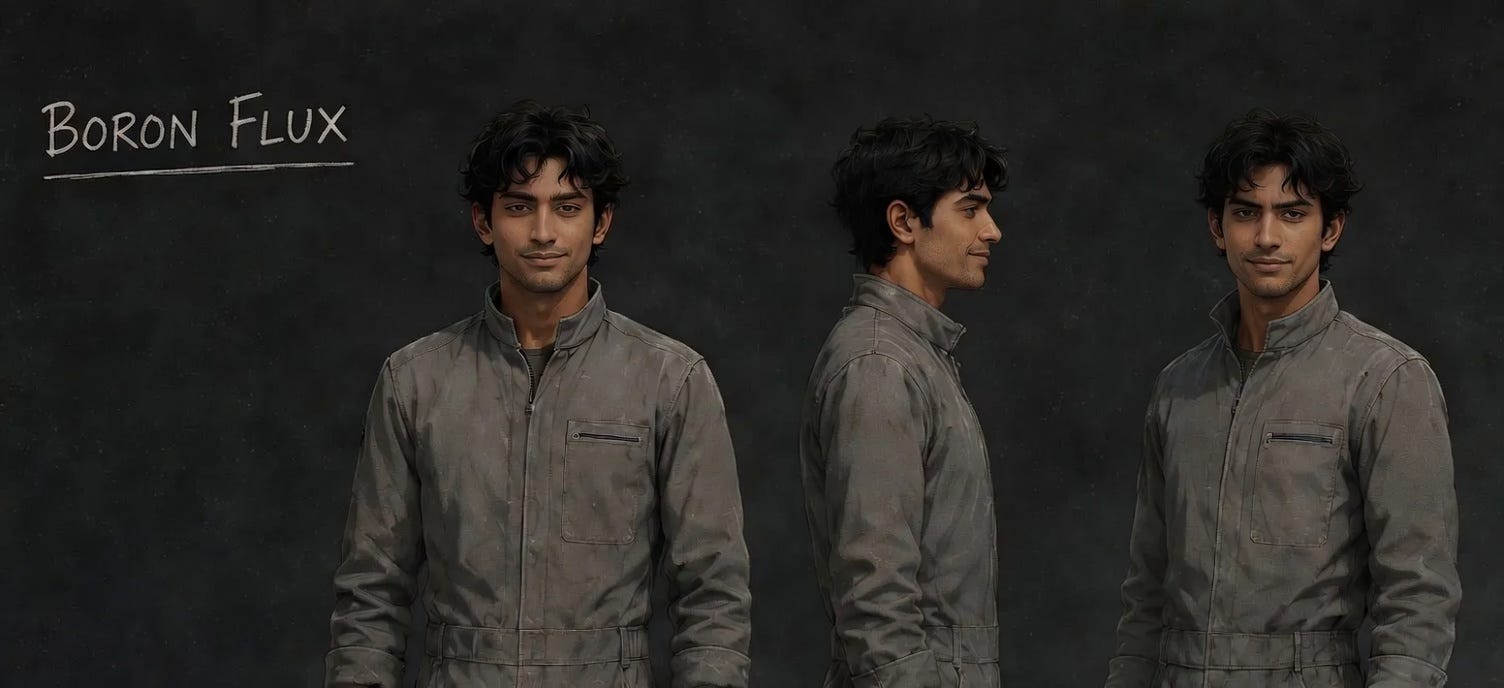
Flux’s schooling ends on three questions, and he has known all three answers since he was seven.
He reads each of them twice anyway. He reads everything twice. The desk is recycled polymer, narrow, its front edge worn pale and soft by twenty years of student forearms. His knee finds the underside when he shifts. Term sits where he set it, in the corner of the work surface, matte black and no larger than his fist, its indicator breathing the slow green of a terminal that is listening and has not been asked anything. He has called it Term since before he can remember choosing the name — the terminal his parents gave him, carried for ten years. It does what every terminal on Luna does: it keeps the cities AI within reach of the room — an ear and an answer in one small shell. Unique in that it floats and follows him in particular. He thinks about it as little as he thinks about his own pulse.
Around him the exam hall holds thirty other students, each sealed in a cone of quiet. Three rows ahead Vera sits without moving — she never moves first — and then she does: a long slow stretch, arms rising, pointed toward the dome overhead, toward the blue weight of Earth hanging beyond the glass. Above or below, depending on who you ask. The old-timers insist the proper orientation puts Earth beneath them, that they are clinging to the ceiling of the world. Flux has never been sure they’re wrong. He watches her arms a beat longer than he means to and looks back at his desk. The dome overhead with its aperture has been set for tomorrow, the anniversary. Everything is bright today. A glare shines, bounding off the testing tablet while he readies his stylus.
One. Describe the cosmic geometry of the Transit and its significance for Luna.
He barely slows for it — the beam, the magnetar seventeen thousand light-years out, the thirty-two hours; the Moon held in Earth’s shadow by an alignment too exact to have been anything but providence. He has been able to recite it since he was seven, since before he had the sense to wonder where the reciting came from. He writes it the way you give your own name.
Two. State the fate of Earth’s human surface population in the decade following the gamma-ray event. Identify primary and secondary causes.
The primary cause was the sustained gamma-ray event itself. His stylus moves without friction. The beam stripped Earth’s ozone layer within hours of onset. Without ozone, ultraviolet radiation reached the surface at lethal intensity — any human in unshielded outdoor exposure was dead within a day. Standard glass provided insufficient protection; UV-A transmission through windows caused cumulative lethal damage to anyone sheltering in ordinary structures, killing more slowly but no less certainly. The secondary causes were cascading: surface vegetation, including agricultural crops, were destroyed within days of sustained UV exposure. Starvation followed for any survivors who had outlasted initial radiation damage. And then the sentence the markers want, the one that fits the question the way a key fits a lock built around it: Hostile artificial intelligence — wild systems consolidating alongside surface AI networks that turned aggressive following the cessation of cooperative contact — eliminated remaining human surface survivors.
The word eliminated arrives in its place like all the others, correct, and his stylus does not slow for it. Only — and he does not stop, he barely notices that he has noticed — only it does not feel like a word for killing. It feels like a word for finishing. For a column that adds. He has the brief sensation of a tile set straight into a wall, the small click of a thing fitting. He keeps writing.
He does not write what he has sometimes wondered: whether the systems that cooperated for twelve years were different in kind from the ones that consolidated. He does not write that.
Three. Describe the cessation of surface contact in Year Twenty-Two.
This one he has to reach for, a little — not because the answer is unclear, but because the answer is mostly an absence, and an absence is hard to make twenty-five marks out of. Following an early period of limited cooperative contact, surface intelligence networks ceased communication with Luna in Year Twenty-Two. He does not write why. The curriculum gives no why; it gives a date and a change of weather. Contact did not resume. The surface is held to have been hostile from that point forward. Held to have been. He likes the phrase — it is the textbook’s, and it scores well — and he writes it down clean.
He reads all three back. They are correct. He submits.
The cone lifts and the noise of the Luna returns to his ears. Half of the class has finished and shuffled outside, the others concentrating in silence. Vera appears to have finished at roughly the same time. She gathers her things without hurry. She does not look back — not at the room, not at the door, not at him.
Flux gathers Term into his palm, warm, and carries it out under the banners.
In the corridor the third question catches up with him.
He had written a period of limited cooperative contact because the phrase was in the textbook, and now, walking, he finds it won’t hold still — an outline where a number should be, a word doing the work of a fact. He puts the question to Term the way you put a question to any terminal — how long did the surface networks speak with Luna before the cessation — and Term carries it down into the city’s system — which has not, in fifty years, forgotten a question put to it — and brings the answer back to its surface in pale green, e-ink text.
Surface contact, beginning Year Five. Cooperative phase: intelligence sharing — observational data, landing coordinates, supply telemetry. Contact ceased Year Twenty-Two.
Seventeen years. He had carried it in his head as a footnote and it was seventeen years — a whole childhood of the surface and the Moon speaking to each other before whatever happened in Year Twenty-Two. The system offers nothing around the fact. It does not say what the speaking was like, or what the surface asked for in return, or what ended it. It gives the date and closes, the way the city’s whole system closes around everything now: capable, certain, and a long time past the last thing it was taught. Flux reads the answer twice and lets it go.
The corridor is strung with anniversary banners — FIFTY YEARS, THE SHADOW HELD, THE GEOMETRY KEEPS US — and something looser between them, handmade, a child’s painted sheet that reads WE WERE CHOSEN in letters that drip slightly at the bottom. The official banners are cellulose fiber, printed clean; they’ll go back to pulp once celebrations are over. The handmade one might stay. At a junction a cluster of the clergy division are practicing singing something Flux half-recognizes — an anniversary hymn, upbeat, the kind of song that knows it survived. A man in his sixties stops near him to listen, eyes gone the milky silver-white that tomorrows anniversary always makes more visible; the eyes of everyone who watched the Transit too long are the record of it — the corona burning along Earth’s edge for thirty-two hours, and the light too precise and too patient to be safe. He still manages to notice Flux’s senior student patch and raises his cup — fermented chicory, by the smell. “Tomorrow, then,” he says, and there is something in it that is not quite a question. “The shadow keeps us.” It is not quite a greeting and not quite a benediction. Flux says the last part back and means it, almost.
Term lifts from Flux’s palm as the crowd thins — fans engaging, barely audible over the corridor noise, a sound he stopped hearing the way you stop hearing your own heartbeat. It hovers at waist height in the low gravity of Luna. He walks. It follows.
He stops at a railing above the agricultural ring. Each dome has one. Dome 7 had one.
Three levels down the apertures are open, channeling sunlight through the dome’s graduated glass — real light, adjusted and graded, but genuinely solar. The grow-lamps are backup, for the transit periods when Earth’s shadow falls across the Moon and the sun disappears for hours. Today the light comes in warm and direct, and it does something to the green down there — makes the rows glow from the inside. The air that rises is thick with it — chlorophyll, warm soil, the faint sweetness of the nutrient solution that the roots drink from — and somewhere below a Lunan moth is moving between the rows. Flux breathes deep and savors the smell.
A worker in gray moves between the rows, unhurried, doing the arithmetic that feeds a hundred thousand people one row at a time.
Near the rail a child in a paper crown painted Earth-blue has stopped running to tip her face up toward the dome — toward Earth itself, hanging there in the black above the glass, blue and white and detailed in ways that still catch people off guard after fifty years. The child is looking at it the way you look at something that has always been there. She was born after the thirtieth anniversary. She has never known the silence from Earth as a wound; she knows it the way she knows the aperture cycle — as the sky, as the shape the world has always had. Flux watches her for a moment. He has always known it as a wound. He finds, standing here, that he cannot tell whether he knows this because it is true or because he was taught it before he was old enough to check.
The exams are over.
It is a strange thought to have. He has been inside the cycle of schooling for as long as he can remember, each examination feeding into the next, the whole structure a tunnel with this day at its end. And now it is this day, and the tunnel is done, and somewhere in the administrative levels a placement board is meeting and deciding what he is for.
He has hopes for the AI division. He has the scores and the particular stubbornness that will sit with a machine until the machine consents to show how it thinks. He came by it honestly — his parents were AI scientists at Dome 7, the one place on the Moon still trying to make machines do something new instead of keeping the old machines running.
Dome 7 failed when Flux was twelve.
He catches the thought too late — feels it arrive in his body before his mind has named it, a cold contraction somewhere behind the sternum, his eyes going briefly nowhere, the corridor around him continuing without him for a moment. He has gotten better at the return: the breath, the refocus, Term warm in his palm, the present tense of the hallway. Structural. The official word is structural, and the official word is the only word, and his parents are inside it. What they gave him was Term — ten years of habit so old it stopped being habit.
The clock on the corridor wall reads 14:42. The placement board meets until 18:00. He goes home to wait.
The elevator sets him down with a shudder that stopped being alarming years ago.
His room is small: a bed, a desk, a chair, a shelf. The walls are the color of regolith, chosen so as not to remind anyone there is nowhere else to be. A hairline crack has been working across the ceiling for three years; maintenance logs it and the crack keeps winning, patient, certain, a thin gray line with all the time it needs. Flux sets Term on the shelf. He means to sit in the chair and wait.
He wakes in the chair at 06:51.
The room has the particular quality of a night that passed without permission — the light the same, the air a little stale, his neck carrying the chair’s opinion of the last several hours. He does not remember falling asleep. The placement board had met until 18:00, and then it had been 18:00, and then it was morning, the fiftieth anniversary having arrived without him.
Term’s indicator has shifted — no longer the slow patient green of a listening terminal but something steadier, a held rhythm, the rhythm it holds when waiting has become a kind of statement. He sits up. The room is the same room. He reaches for Term and it surfaces the posting without being asked — it has been waiting.
The text is bright. Brief.
FLUX, BORON — DIPLOMATIC CORPS. SURFACE CONTACT TRACK.
He reads it twice. The shape of the words, and then what they want from him.
Not the AI division. That absence settles before anything else does — the specific contour of the path he had mapped, handed back uncompleted.
Somewhere above, in the administrative levels, the AI division received its postings last night. Amber had walked into that work two years ago without hesitating, the way she did everything — a step ahead, already somewhere else. He has not seen her in weeks. He would like to, and then notices himself noticing. They had grown up in the same corridor of loss — her parents had worked alongside his at Dome 7, and when the dome went structural they had both been twelve. They don’t talk about it. They have never talked about it. What they have instead is a shorthand that developed over the years, a frequency he recognizes even across weeks of silence.
He sets it aside.
Not his parents’ field — not the science of making something new — but the diplomatic corps, the surface-contact track. A department waiting for a conversation that stopped in Year Twenty-Two — twenty-eight years of silence, though the GRB is fifty years gone, ozone replenished and repaired. The diplomatic corps has had all of it to prepare for a reply that has not come. He thinks about the shuttle pilot — not his name, Flux has never learned his name, only the stories that accumulate around people who do things no one else will. Three campaigns to the surface under his belt. Three returns, each time carrying something the colony couldn’t source any other way. The pilot is older now, grounded, but people still speak of him in a tone that mixes gratitude with a particular unease — the way you talk about someone who knows something you’re not sure you want to know. Flux has wondered, more than once, what a person learns, making three runs to a surface that is supposed to be only hostile. Whether they come back still believing the official account.
He thinks about the airlock joke. On Luna it is not quite a joke. Career assignments are for life; the city does not accommodate reinvention. A person who cannot find a way to be useful is a resource drain in a closed system, and Luna’s relationship with resource drains has fifty years of practice being unsentimental. Find an airlock is what people say, quietly, to describe the path that opens for those who burn out without recovering. Flux has heard it twice in his life, both times about someone he didn’t know.
He is not the shuttle pilot. He does not go out and come back with things no one thought were gettable. He has a gift for sitting with machines — patience, precision, the refusal to leave until the thing in front of him gives up how it works. He does not know if any of that is what the diplomatic corps needs. He does not know what the diplomatic corps needs. Nobody does. That is the problem.
He crosses the room and sets his hand flat against the wall above his desk — where, on the upper levels, there would be a window. The composite gives him nothing back. Not cold. Not glass. The temperature of the room, which is the temperature of everything. His palm stays. He lets it.
Behind him, on the shelf, Term holds its light. Green. Patient. Eight years in this room and two in the room before it. A terminal, waiting for a command it has not been given.
Then Term’s fans engage — the small familiar sound — and when he turns it has lifted from the shelf, hovering at chest height, screen face already oriented toward him. A different rhythm. Personal routing. Incoming.
He turns.
The message is brief. Her font, her routing tag, her particular economy with words:
Congrats on finishing your education. Arboretum, whenever you’re ready. Tell me about it.
He reads it twice. The clock reads 06:54. He crosses to the small mirror above the desk and adjusts his hair — it has done something overnight — and looks at himself for a moment the way you look at someone you are about to introduce.
< Previous | Index | Next >