Transit
Prologue

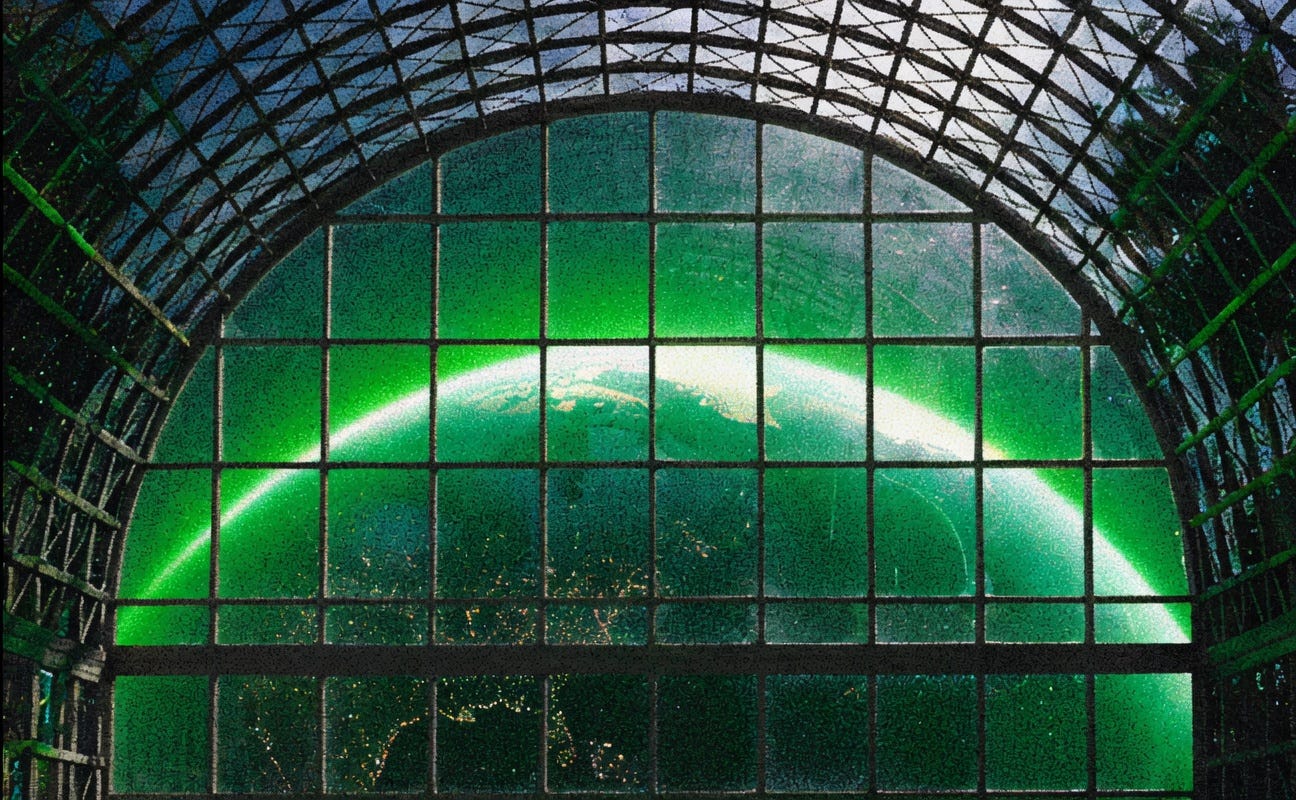
The transmission begins at 3:17 in the morning, Pacific Standard Time.
She is the relay technician on shift. Forty-third time she has run this seat. The signal comes up clean, the handshake completes, and the data begins moving through the dark the way data moves — without ceremony, without anything that announces itself as significant. Large classified file. Unusual hour. Not her concern.
She logs it. She pours a second coffee from the urn that the kitchen on level B keeps too acidic and never adjusts. She watches the compression counter tick upward.
She watches the Earth.
Everyone watches the Earth. It hangs above the surface dome — blue and white, detailed in ways that still surprise her after three years, that still catch in her chest when she forgets to expect them. She has not gotten used to it. She is not sure she wants to.
The Earth looks normal.
That is, for now.
At hour two a light begins to build along Earth’s limb.
Not a sunrise. Not aurora. Something that comes from the wrong direction — a corona, faint at first, spreading along the edge of the disk. She watches it the way you watch something you don’t have language for yet. The senior technician comes to stand beside her. Neither of them speaks for a long time.
It is extraordinary. That is the word that keeps arriving and failing. Extraordinary. Earth above them, lit from behind by something vast and patient and very far away, wearing its own atmosphere like a halo, every water-vapor cloud on the edge burning pale and perfect, the whole planet thrown into a kind of terrible relief she has never seen and will not see again.
She will spend the rest of her life trying to describe it to people who weren’t there. She will never get it right. Beautiful is wrong. Terrifying is wrong. Both together are closer and still not enough. It is the kind of thing that arrives before you have the category for it.
“What is that,” someone behind her says. Not a question.
She has stopped blinking. She makes herself blink. The glass window she peers from cools her forehead when she leans.
São Paulo’s handshake stays up at hour three.
That is the thing that stops her. The São Paulo AI is still talking — still routing, still acknowledging, still polite. What goes quiet is everything behind the handshake. The route to the human queue. The on-call paging system. The escalation chain. The São Paulo AI sends her the routine handshake and then sends, attached, a request for human authorization on a query nobody has touched, and waits.
She keys the retry. Not because she expects the AI to be the problem. Because she does not know how else to ask after the missing person on the other side.
At hour four someone in São Paulo authorizes a queue clearance. The timestamp comes through, the AI accepts it, and three minutes later the same authorization queue runs again asking for someone else. Whoever just signed off is not at their station anymore. The next request waits. She watches it wait.
Nairobi is the same at hour five. The Nairobi grid AI is patient. It logs a power-routing request, addressed to a supervisor whose credentials nobody has used in two hours. It sends a follow-up. It sends a courtesy reminder. The whole thing has the rhythm of a building still running its evening systems on schedule with no one inside.
Mumbai at hour six. The Mumbai hospital triage AI is paging surgeons in priority order. It is on the fourteenth name on its list. Someone in operations has the page-feed on a monitor — she does not know who set that up or why it is showing. The fourteenth name is not responding. Neither is the fifteenth.
Her hand is shaking. She presses her palm flat against the console to stop it. There is no handshake to retry. The handshakes are fine. The handshakes are the only thing that is fine.
“The beam is fixed,” the senior technician says, when he comes back from the calls. His voice has the quality of someone reporting facts because facts are the only thing left. “It doesn’t move. They’re rotating into it.”
She understands then. The far side of that disk — the side facing away from the Moon, the side she cannot see — is inside it. Has been inside it. The contacts are not falling silent in sequence because the systems are dying. They are falling silent because the humans are. The AIs on Earth’s far side keep talking, continent by continent, asking permission from people who can no longer answer. The beam doesn’t chase anyone. It simply stays where it is. Earth does the rest.
The corona along the edge of the earth intensifies. She cannot look away from it. She has stopped trying.
The senior tech says, very quietly, “They keep going to the windows. To look at the sky. It’s brown from earth.” He does not elaborate. He is crying.
Her right shoulder has gone locked from holding the same posture. She does not move it.
Visors and ponchos start moving through the station at hour six. Standard surface-walk UV gear, pulled from stores and handed out without explanation because the explanation is already on every face. Someone sets one of each at her console. She does not stop to look. She tucks them under the desk at her feet, where she can reach them without leaving the window.
The city begins shuttering after the visors come out.
Residential domes first. Children and non-essential personnel sealed under regolith composite, Earth gone from their windows, the protocol that has never been used at city scale moving through the corridors with the slow authority of a thing finally needing to be true. The corridor outside operations was fully lit when she started her shift. By hour eight it is a quarter as bright. By hour twelve the only light in her station comes from her console and the corona. The agricultural rings stay open by mandate — the lamp cycle is its own organ and the crops do not know what is happening. Observation domes go to their darkest filter and stay watching. The city has closed most of its eyes. A few are still staring.
Hers is one of them.
By hour seven the word chosen is moving through the station.
She hears it first in the corridor outside operations, low and not quite serious, the way people say things they want to test in the air before they decide to believe them. She hears it again at the coffee urn, with more weight. By hour nine nobody is saying it ironically.
The math is too tight. That’s what the engineer two stations down keeps repeating, to anyone who will listen, to the window, to himself. The transit. The math is too tight. He uses the word the way a person uses a word that he has just discovered fits — turning it slightly, finding the angle that locks it in. We are in the transit. We are sheltered. The same engineer keeps the orbital number on his screen. He has been running it since hour four. He updates it every hour. Twenty-two hours of shelter remaining. Then twenty-one. Then eighteen. He says the number flat each time, the way you say a number you have already checked three ways. He does not say and we do not know how long the beam will last. No one asks him to.
She knows the math. She has run the numbers herself by now because there is nothing else to do, and the numbers are not comfortable. The geometry that put the Moon in Earth’s shadow at precisely this moment — the alignment, the angle, the arc — does not feel like coincidence in the way that coincidences feel. It feels like the kind of thing that happens once in the life of a solar system, if that.
She does not say it. She watches the corona burn along Earth’s edge, brilliant and patient and moving the way weather moves, with the slow authority of something that has made up its mind, and she thinks about the forty-seven cities that have stopped answering with real human intention.
The compression counter keeps ticking, still receiving the classified download. She wonders about its significance. Her coffee has gone cold without her noticing. She drinks it anyway. The cold of it is the first thing her mouth has registered in three hours, and the metallic tang of it is the only thing she will remember about it later.
North America meets the beam at hour seven.
She has stopped keying São Paulo.
The Earth turns as it has always turned. The corona holds. She stays at the window because leaving would mean something she is not ready for it to mean. This is all she can do now and she does it fully, without looking away, watching Earth wear its halo and go quiet underneath it — still blue, still white, still looking precisely like itself, which is the most wrong thing of all.
The mysterious transmission completes at hour eleven.
One hundred percent. She stares at the counter. It came through before the North American contacts fell silent. Someone very important on that planet decided, in the middle of everything, that this was worth sending. Packaged it. Aimed it at the Moon. Let it go.
The download is filed to a server with the eyes allowed to see it, unopened. It leaves her mind.
She stays at the window.
The beam holds for thirty-two hours.
It does not move. Earth moves through it — turning with the same fidelity it has turned for four billion years, carrying each new face into the path of something that was simply there, waiting, that crossed a long distance to arrive at this exact alignment and will not be arriving again.
The Moon holds in Earth’s shadow. Safe the way something is safe when it did not know the danger existed — when the planet below it took the hit without knowing, shielded without choosing, stood between its moon and the dark by the pure accident of where it happened to be. A degree of arc. An hour either way.
The math is too tight.
By hour twenty the engineer has stopped saying the number out loud. He keeps it on his screen. Six. Then four. Then two and a half. The beam is still active. The shadow has the runway it has. Nobody in operations does anything but watch — the corona, the counter, the corona, the counter — the way you watch two clocks at a finish line when only one of them can win.
At hour thirty-one and change, the corona begins to thin.
Nobody trusts it for the first minute. It has not flickered in thirty hours. The change is so gradual it could be the eyes giving up. The deck AI flags the attenuation curve on the main monitor — neutral, certain, a number with a slope, the only witness in the room with eyes that have not been failing for thirty hours. Even then nobody trusts it. By the second minute it is real. By the third minute the engineer puts both palms flat on his console and does not speak.
At hour thirty-two, Earth’s rotation carries the last surface out the other side. The corona is gone. The beam ends, already somewhere else, indifferent, moving on at the speed of light toward whatever comes next.
The Earth turns in ordinary dark.
The shelter number on the engineer’s screen reads forty-seven minutes. That is how close it was. Nobody will be able to look at that number later without feeling the rest of it open under them.
She has been awake for thirty-two hours.
So has most of the Moon. That is the thing she will learn later — how almost no one slept, how the population of every dome pressed against every window and screen and stayed there, watching the corona burn along Earth’s edge, running the geometry in their heads. The Transit held them in Earth’s shadow but the shadow has edges. The math is tight. They watched and waited and did the math again.
When the corona fades, there is no alarm. No announcement. The systems are nominal. The domes are intact.
The Earth sits above them, blue and white and silent.
Her right shoulder will not unlock. She tries to roll it and the muscle has the consistency of something that has forgotten what it was for. Her back is the next thing. Her feet. She has been standing for what her body now informs her was a very long time. The air in the station tastes the way Luna air tastes when you have not noticed it for two days — sweet-plastic, recycled, the faintly chemical signature of a place that has remembered to keep you alive while you forgot to participate.
She presses her hand against the dome glass.
The Earth does not answer.
The cold of it travels into her palm slowly. She lets it. Her forehead joins her hand a moment later, and the cold there is something more honest than anything that has happened in thirty-two hours.
Behind her, in the operations center, she can hear the shift changing — voices low, careful, the particular quiet of people who have been frightened for a long time and are only now beginning to let it go. Somewhere in the residential domes, in the agricultural rings, in the schools and the machine shops and the water reclamation corridors, a hundred thousand people are doing the same arithmetic she is doing. The shadow held. The geometry was right. The Moon is intact — its domes, its crops, its children, its accumulated decades of making a city out of rock and recycled air and stubbornness. Damaged, maybe. Diminished, certainly. But here. Still here.
In the agricultural rings the lamp cycle held all the way through. The chief agronomist, who has not slept either, walks the longest aisle and counts her rows and finds them where she left them. The Moon will eat. That part of the arithmetic resolves clean.
On the relay deck the handshake bands are mostly dark by now. The few that still answer are AIs nobody is talking to — answering protocol queries to no one, holding ports open for ships that have not transmitted in twenty hours, accepting authorizations that never come. The cargo manifests still show as scheduled — Pacific Northwest, Singapore, Brittany — and the timestamps roll forward and no signals come up to meet them. Nobody on the deck is willing to clear them yet. Clearing them would be a thing decided. Right now they are still scheduled. Right now nothing has been decided. That is the only kindness left in the room.
The general bands are not silent. Somebody in operations has them on a speaker. A Lagos traffic AI is still managing morning intersections, requesting authorization on edge cases that have not been authorized in nine hours, then auto-approving in the most conservative mode it has. The Mumbai hospital triage AI has reached the bottom of its on-call list and started over from the top, more politely each time. A Singapore power grid AI is requesting load-shedding permission and falling back to default schedule when no one answers. A submarine somewhere in the Pacific is still pinging a port AI in San Diego. The port AI is answering. The submarine pings again. Neither side knows yet what they are talking to. The bands are alive the way a body is alive after the person inside it has left.
A hand settles on her shoulder. Not the locked one. The other.
“Hey.” One of the overnight engineers. His voice is gentle in the way voices get when someone has been awake too long and is past the edge of what words can do. “It held. We’re okay.” He pauses. “Come get some sleep.”
She looks at Earth one more moment. Blue and white. Silent. The corona gone, the limb just a limb again, ordinary against the dark.
She lets him lead her away from the glass.
Her palm leaves a shape on the dome. Heat-print. It fades while she is still in the room. By the time she reaches the corridor it is gone.